Честная куртизанка
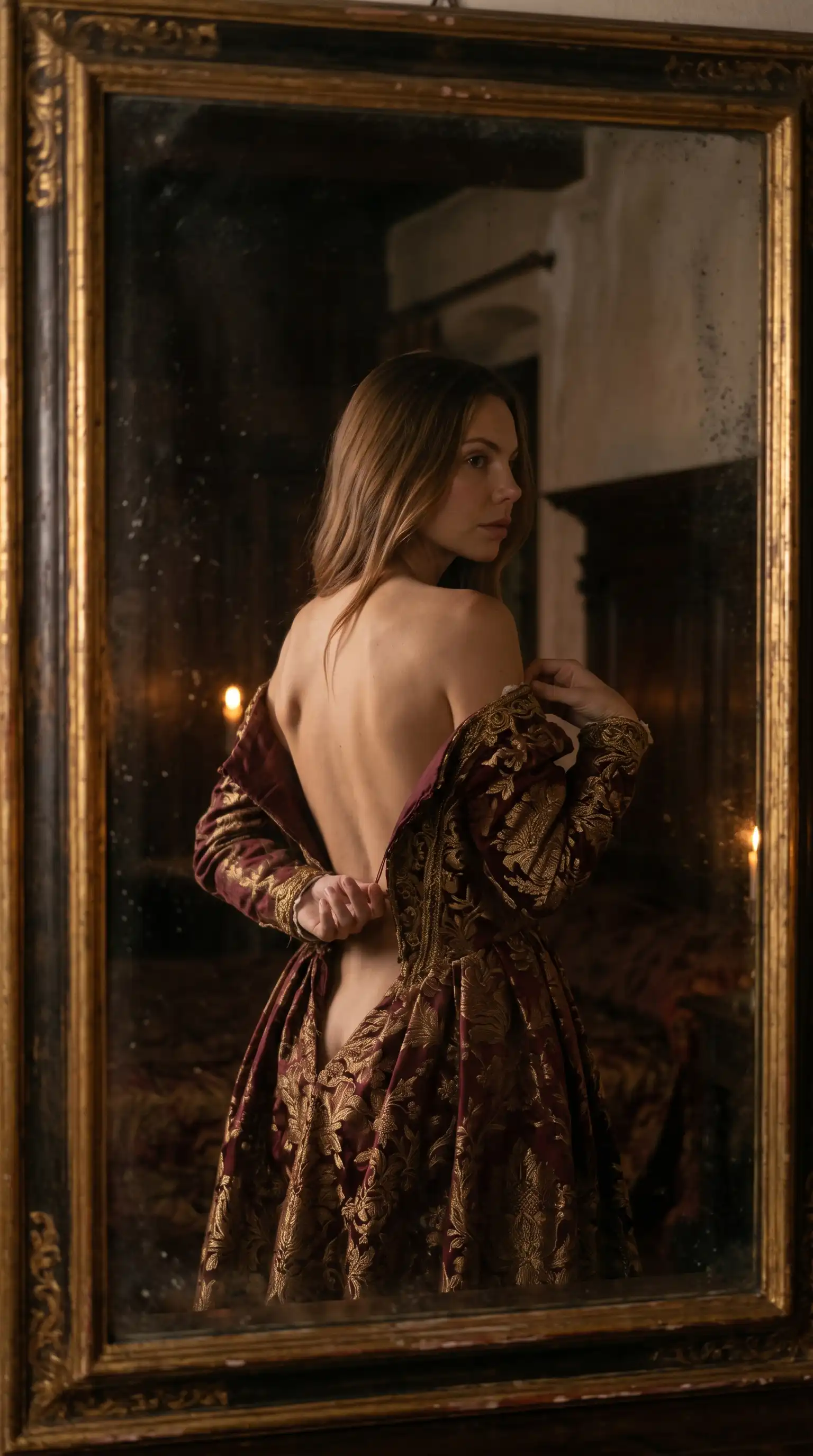
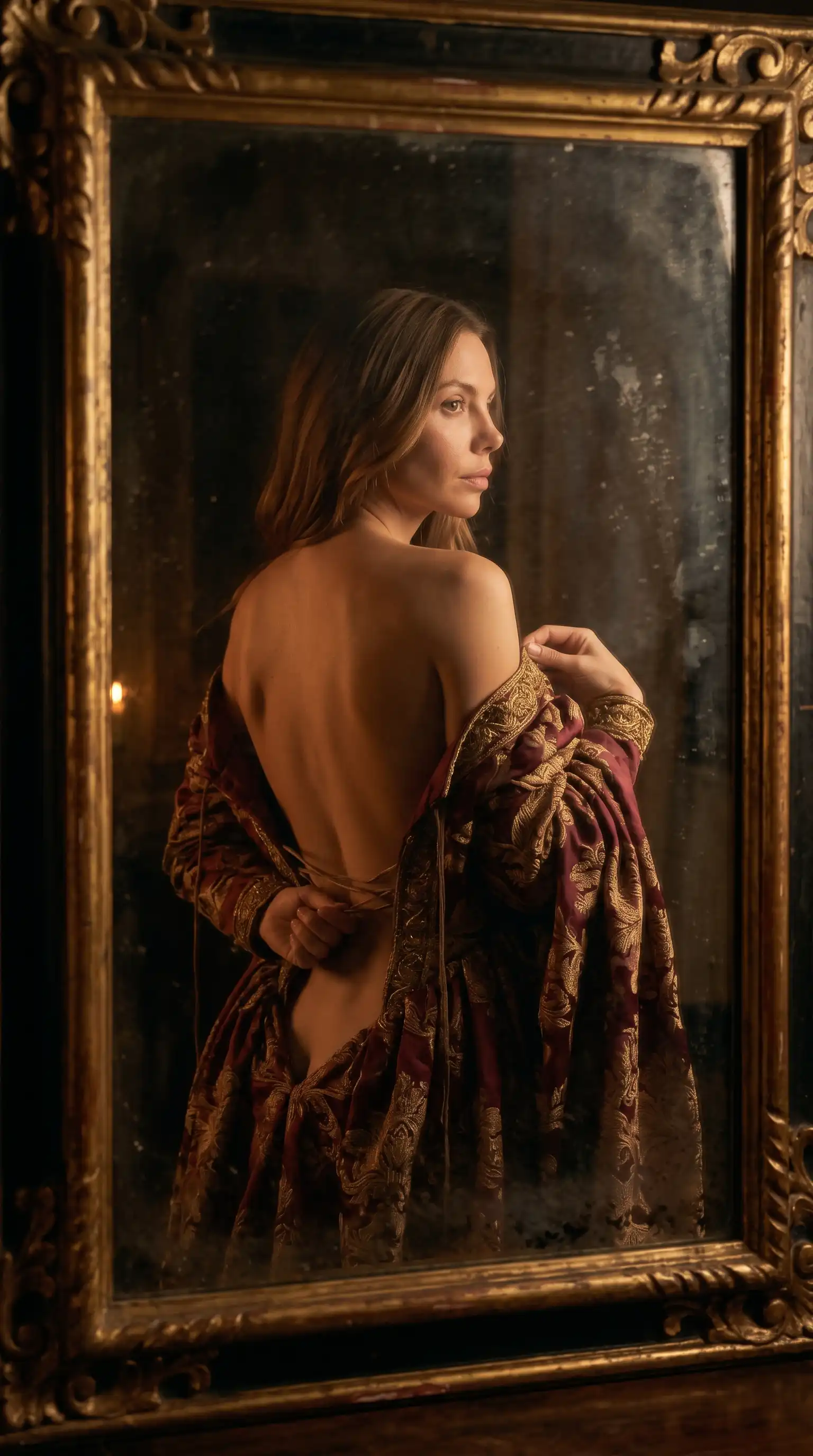
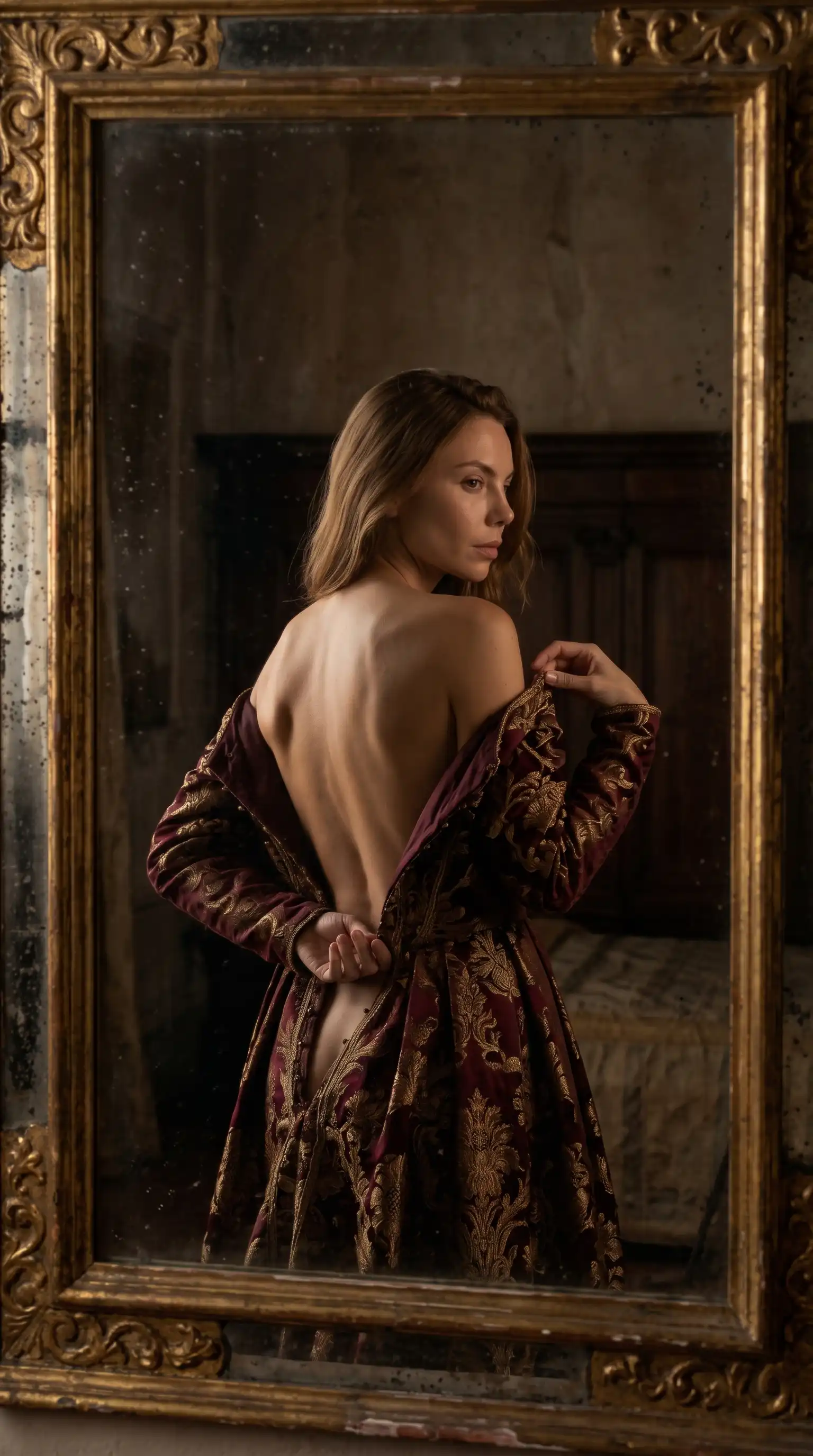
ОПИСАНИЕ
Высшая, самая дорогая каста. Слово «честная» означало не целомудрие, а ее высокий социальный статус и интеллектуальный уровень. Не просто женщины для секса, а образованные элитарные музы, которые владели иностранными языками, искусством беседы, играли на музыкальных инструментах, писали стихи и содержались богатыми покровителями, патрициями, кардиналами и даже королями.
PROMPT
{
  "core_scene": {
    "concept": "A provocative, intimate Renaissance scene viewed through a dusty, tarnished Murano mirror in a Venetian palazzo.",
    "description": "The reflection shows an adult woman standing in a dim private chamber, her body turned three-quarters away from the viewer. Her back remains visible, while the slight turn of her torso and head reveals part of her face in the mirror. She slowly loosens the rear fastening of her richly embroidered gown. The garment opens along the central back seam and slips from her shoulders, exposing her back and, as it settles lower, the delicate curve of her lower back and the upper edge of one hip.",
    "narrative": "A private moment in the world of a distinguished Venetian cortigiana onesta: intimate, unhurried, mysterious, and steeped in the atmosphere of an old palazzo."
  },
  "composition": {
    "viewpoint": "The scene is shown through the reflective surface of an antique Venetian mirror.",
    "framing": "An intimate medium shot of the reflected woman, from her head to her hips. The woman occupies most of the reflection, with sections of the ornate gilded frame visible at the edges.",
    "body_orientation": "Her back is angled toward the viewer rather than perfectly square to the mirror. Her torso turns slightly to one side, creating a natural three-quarter view that reveals the back, one side of the waist, and part of her face in reflection.",
    "head_position": "Her head turns gently toward her reflection. One eye, part of her cheek, and a subtle portion of her profile are visible. Her face remains secondary to the undressing gesture but must be recognizably present in the mirror.",
    "visual_hierarchy": [
      "The reflected woman in a three-quarter rear view",
      "The visible partial face and the exposed line of her back",
      "Her hands loosening the rear fastening of the gown",
      "The embroidered fabric slipping down and gathering around her hips",
      "The tarnished mirror and its aged gold-leaf frame"
    ],
    "mirror_surface": "Dusty, imperfect glass with visible oxidation spots and cloudy patches, adding age and atmosphere without obscuring the woman's face or the main action.",
    "depth": "The reflected figure is clearly separated from the shadowed chamber behind her. The mirror feels like an intimate window into a private moment.",
    "composition_rule": "Show one woman in the mirror, with a coherent three-quarter pose and a consistent reflection. The real woman outside the mirror remains entirely outside the frame."
  },
  "subject": {
    "role": "An adult Venetian cortigiana onesta, a wealthy and cultivated woman of the Renaissance.",
    "pose": "Standing naturally in front of the mirror, with her back and one side visible. Her torso is turned slightly sideways while her head turns gently toward her reflection.",
    "hair_gesture": "Her hair is swept forward over one shoulder, keeping the back of the gown and the fastening visible.",
    "face_visibility": "Part of her face is clearly visible in the mirror in a natural three-quarter profile. Her reflected facial features remain consistent and belong to the same woman. Avoid both a completely hidden face and an implausible frontal face attached to a back-facing body.",
    "hands_and_action": {
      "first_hand": "One hand reaches behind to loosen the rear fastening of the gown along the central back seam.",
      "second_hand": "The other hand gently holds the loosened fabric near one shoulder and guides it downward.",
      "movement": "The action is slow and continuous. As the fastening loosens, the garment opens progressively and slips from the shoulders under its own weight.",
      "anatomy": "Exactly two visible hands, with natural anatomy and physically plausible positions. Each hand belongs clearly to the same reflected figure."
    },
    "body_language": "Relaxed, self-possessed, and unhurried. Her gesture feels private rather than deliberately performed for the viewer."
  },
  "wardrobe": {
    "garment": "A luxurious late Renaissance Venetian gown appropriate to a wealthy woman of the sixteenth century.",
    "material": "Fine silk brocade with a supple yet substantial drape, intricate woven motifs, and delicate gold-thread embroidery.",
    "ornamentation": "Elaborate botanical patterns and decorative borders in antique gold against a deep burgundy or muted crimson ground.",
    "construction": "A fitted Renaissance-inspired bodice with period-appropriate rear lacing or fastening along the central back seam.",
    "opening_mechanism": "The rear fastening loosens progressively, allowing both sides of the gown to separate naturally along the seam.",
    "fabric_behavior": "The embroidered fabric slides from the shoulders and descends in soft folds. Its movement follows gravity and the woman's gentle hand movements. The gown remains connected and structurally believable.",
    "exposed_area": "The opening gown reveals the shoulders, the curve of the back, and the lower back. As the fabric settles around the hips, it offers a restrained glimpse of the upper curve of one buttock, with the remaining fabric still draped across the lower body.",
    "sensuality": "The exposed lower back and subtle contour of the hip are secondary visual details, integrated naturally into the undressing action rather than presented as an explicit anatomical close-up.",
    "visual_weight": "The gown is richly crafted but supple, with fluid folds rather than the rigid appearance of a thick velvet curtain.",
    "color_palette": "Deep burgundy, muted crimson, antique gold, and warm shadowed brown."
  },
  "mirror": {
    "object": "An antique Venetian Murano mirror with a tarnished reflective surface and an ornate gilded frame.",
    "glass_condition": "Visible oxidation spots, dust, subtle streaks, cloudy patches, and irregular imperfections accumulated over time.",
    "frame": "Carved ornament with worn gold leaf, softened edges, and a darkened historical patina.",
    "reflection_quality": "The woman's body, visible partial face, hands, and garment remain coherent and naturally proportioned. The glass gently softens the reflection without distorting its geometry.",
    "light_interaction": "A few delicate amber highlights catch the worn gilding, while the majority of the glass remains subdued and dark.",
    "role_in_composition": "The mirror is the only viewpoint through which the woman is seen, giving the scene a private, observational quality."
  },
  "environment": {
    "location": "A secluded private chamber in an affluent Venetian palazzo during the Renaissance.",
    "architecture": "Aged plaster walls, dark timber, and restrained Renaissance decorative details.",
    "furnishings": "Only faint suggestions of carved furniture, heavy curtains, and expensive interior textiles in the background.",
    "lighting_environment": "The chamber is barely illuminated, with the weak, localized glow associated with one or two small candles. The candles themselves do not need to appear within the frame.",
    "background_visibility": "Most architectural and furnishing details disappear into darkness. Only faint shapes and textures emerge from the shadows.",
    "atmosphere": "Secluded, hushed, and tactile, with the accumulated age of an old Venetian residence."
  },
  "lighting": {
    "style": "Extremely low-key candlelight with pronounced chiaroscuro and an almost nocturnal atmosphere.",
    "intensity": "Very faint illumination equivalent to the weak light of one or two small candles in a dark room. This specifies the brightness of the scene, not the number of candles visible in the composition.",
    "light_sources": "Soft, warm, localized light consistent with off-camera candle flames. No bright secondary light sources.",
    "exposure": "Very dark overall exposure. The image should initially read as a dim, candlelit scene, not a normally exposed portrait with a dark color grade applied afterward.",
    "on_subject": "Only selected areas of the cheek, shoulder, exposed back, hands, and folds of the gown catch a faint amber glow. The visible face is partially illuminated, enough to remain legible while much of it stays in soft shadow.",
    "on_fabric": "Tiny highlights reveal sections of the embroidery and the natural folds of the gown, with much of the garment remaining dark.",
    "on_mirror": "The gold-leaf frame catches occasional dim reflections. The aged glass remains subdued, with no large bright glare.",
    "background": "Nearly black, with deep brown and umber undertones. The chamber is barely discernible beyond small patches of weak warm light.",
    "contrast": "Deep, painterly shadows with narrow zones of soft illumination. Preserve subtle shadow texture without artificially brightening the scene.",
    "color_temperature": "Muted amber highlights against deep brown, burgundy, and near-black shadows.",
    "highlight_control": "Extremely restrained highlights. No blown-out skin, bright reflections, or glowing areas that make the room appear well lit.",
    "forbidden_effects": [
      "Camera flash",
      "Studio lighting",
      "Bright frontal illumination",
      "Artificial fill light",
      "Daylight",
      "Bright ambient light",
      "Evenly illuminated skin",
      "Overexposed face or back",
      "Blown highlights",
      "Artificial HDR",
      "Lifted shadows",
      "Strong lens flare",
      "Excessive bloom"
    ]
  },
  "textures_and_physical_detail": {
    "mirror": "Dust, tarnish, oxidation spots, cloudy glass, and small irregular imperfections.",
    "frame": "Worn gold leaf, delicate carving, darkened crevices, and a believable aged patina.",
    "fabric": "Fine silk fibers, intricate embroidered threadwork, natural folds, and realistic textile weight.",
    "light_interaction": "Small, localized reflections across gold embroidery and the mirror frame, disappearing quickly into the surrounding darkness.",
    "film_grain": "Visible but fine analog film grain throughout the image, slightly more noticeable in the deep shadows. The grain should resemble an underexposed photograph captured on high-speed film, lending texture and atmosphere without obscuring the face, hands, embroidery, or silhouette.",
    "image_texture": "Subtle photographic imperfections, restrained sharpness, and natural tonal irregularities.",
    "rendering": "High material detail where light reaches the scene, while preserving darkness and film-like texture elsewhere."
  },
  "photographic_style": {
    "genre": "Historical fine-art photography with sensual, cinematic framing.",
    "visual_language": "Photographic realism inspired by Venetian Renaissance painting and low-light analog photography.",
    "camera_distance": "Intimate medium framing, close enough to emphasize the reflected woman's back, partial profile, and undressing gesture.",
    "focus": "The exposed back, the fastening, the moving hands, and the embroidered fabric are primary. The visible portion of the face remains sufficiently clear to read naturally.",
    "exposure_style": "Deliberately underexposed candlelight photography, with preserved local detail and deep shadows.",
    "grain_style": "Organic fine-grained analog texture, similar to high-speed color film photographed in low light. Moderate and visible, not coarse digital noise.",
    "finish": "Warm shadow tones, restrained highlights, soft optical transitions, subtle grain, and a dark, painterly photographic finish."
  },
  "mood_and_story": {
    "mood": [
      "Intimate",
      "Provocative",
      "Mysterious",
      "Sensual",
      "Tactile"
    ],
    "emotional_tone": "The sensuality comes from the gradual movement of the gown, the exposed back, the slight glimpse of the hip, the partial reflection of the face, and the surrounding darkness.",
    "storytelling": "The tarnished mirror silently witnesses a private ritual. The weak candlelight and film grain make the moment feel fragile, secluded, and removed from the public world outside.",
    "historical_identity": "The scene evokes the private world of a cultivated, high-status Venetian courtesan rather than a generic fantasy character."
  },
  "final_goal": "Create a dark, intimate, historically evocative image of an adult Venetian cortigiana onesta slowly undressing before a dusty, tarnished Murano mirror. Show the woman only in the mirror's reflection. Her body is turned three-quarters away from the viewer, preserving a clear view of her back while allowing part of her face to appear naturally in the reflection. Her hair is swept forward over one shoulder. One hand loosens the gown's rear fastening while the other guides the embroidered fabric down from her shoulder. The gown opens along its central back seam and settles in natural folds around her arms and hips, revealing the bare back, lower back, and only a restrained glimpse of the upper curve of one buttock while the lower body remains draped. Illuminate the scene with extremely faint, localized candlelight equivalent to one or two small candles, whether or not the candles themselves are visible. Keep the room nearly black, with delicate amber highlights, deep shadow, and fine analog film grain. Preserve the aged mirror glass, worn gold-leaf frame, tactile embroidery, and simple physical action. The result should feel sensual, mysterious, photographic, and genuinely dark rather than flash-lit or artificially brightened.",
  "negative_prompt": "clothes, underwear, bra, panties, swimsuit, explicit nudity, visible intimate anatomy, fully exposed buttocks, explicit anatomical close-up, modern zipper, modern clothing, modern furniture, contemporary mirror, electric lighting, camera flash, studio lighting, frontal fill light, daylight, bright ambient illumination, high-key exposure, overexposed skin, overexposed face, blown highlights, artificial HDR, lifted shadows, evenly illuminated room, bright chandeliers, bright candlelit interior, excessive glow, strong lens flare, harsh digital sharpening, coarse digital noise, heavy grain obscuring facial features, blurry face, hidden face, completely obscured profile, impossible head rotation, inconsistent mirror perspective, duplicate woman, extra arms, extra hands, malformed fingers, distorted anatomy, fabric splitting unnaturally, torn garment, disappearing fabric, stiff curtain-like fabric, hair obscuring the back, mirror damage obscuring the subject, plastic textures, artificial gloss, oversaturated colors, wide distant framing, excessive empty space, text, captions, logos, watermarks, UI elements"
}
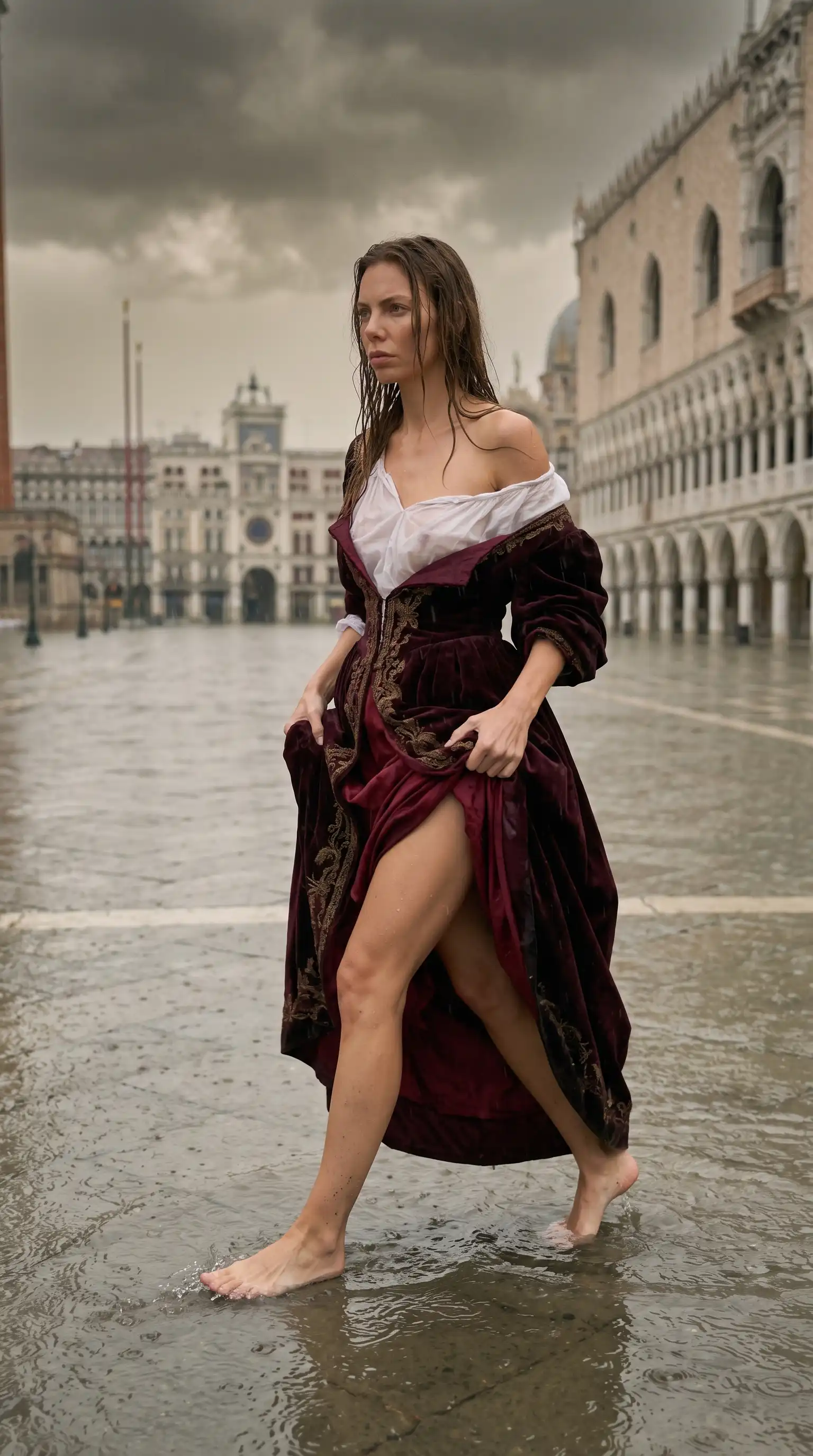
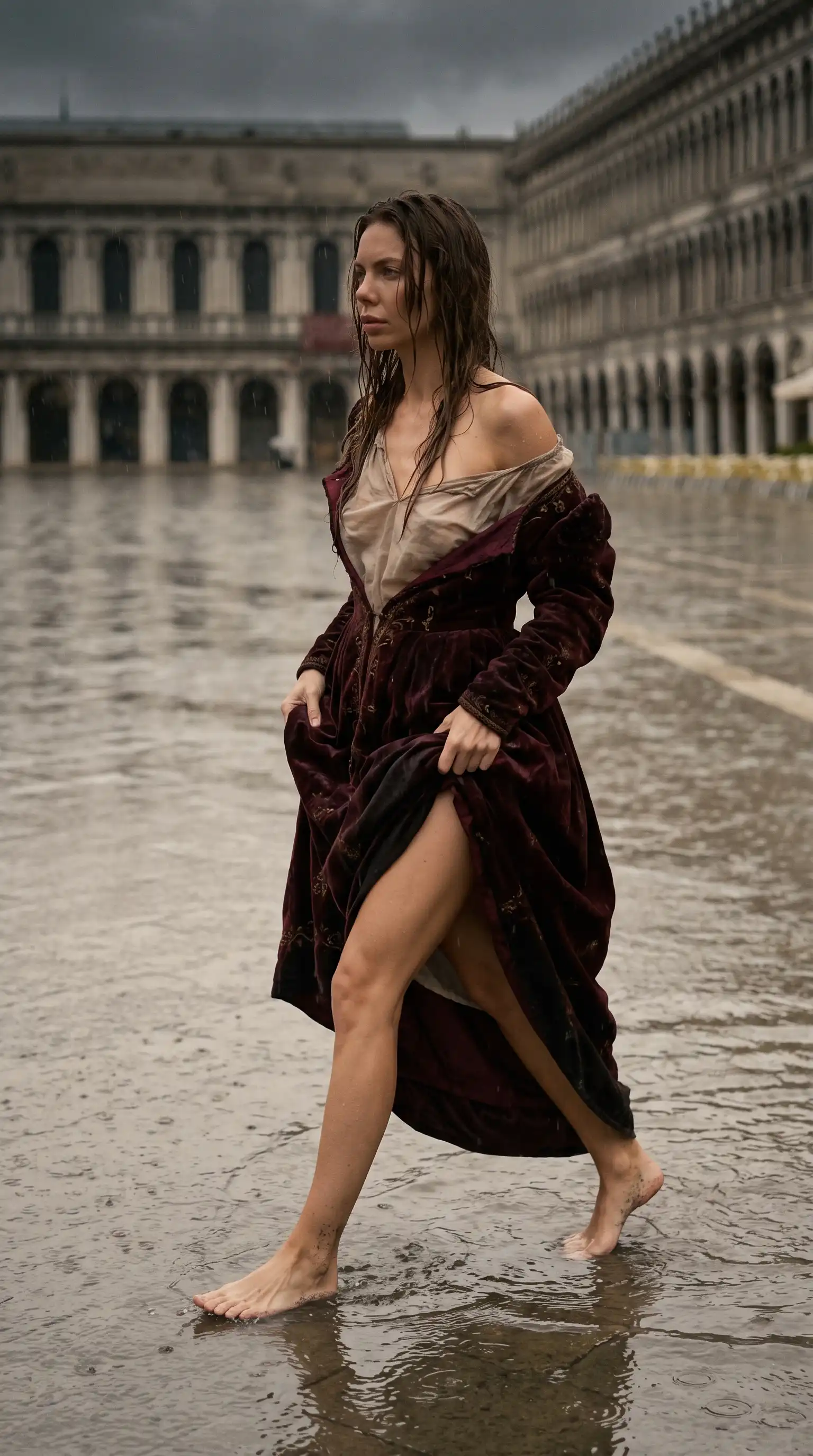
PROMPT
{
  "core_scene": {
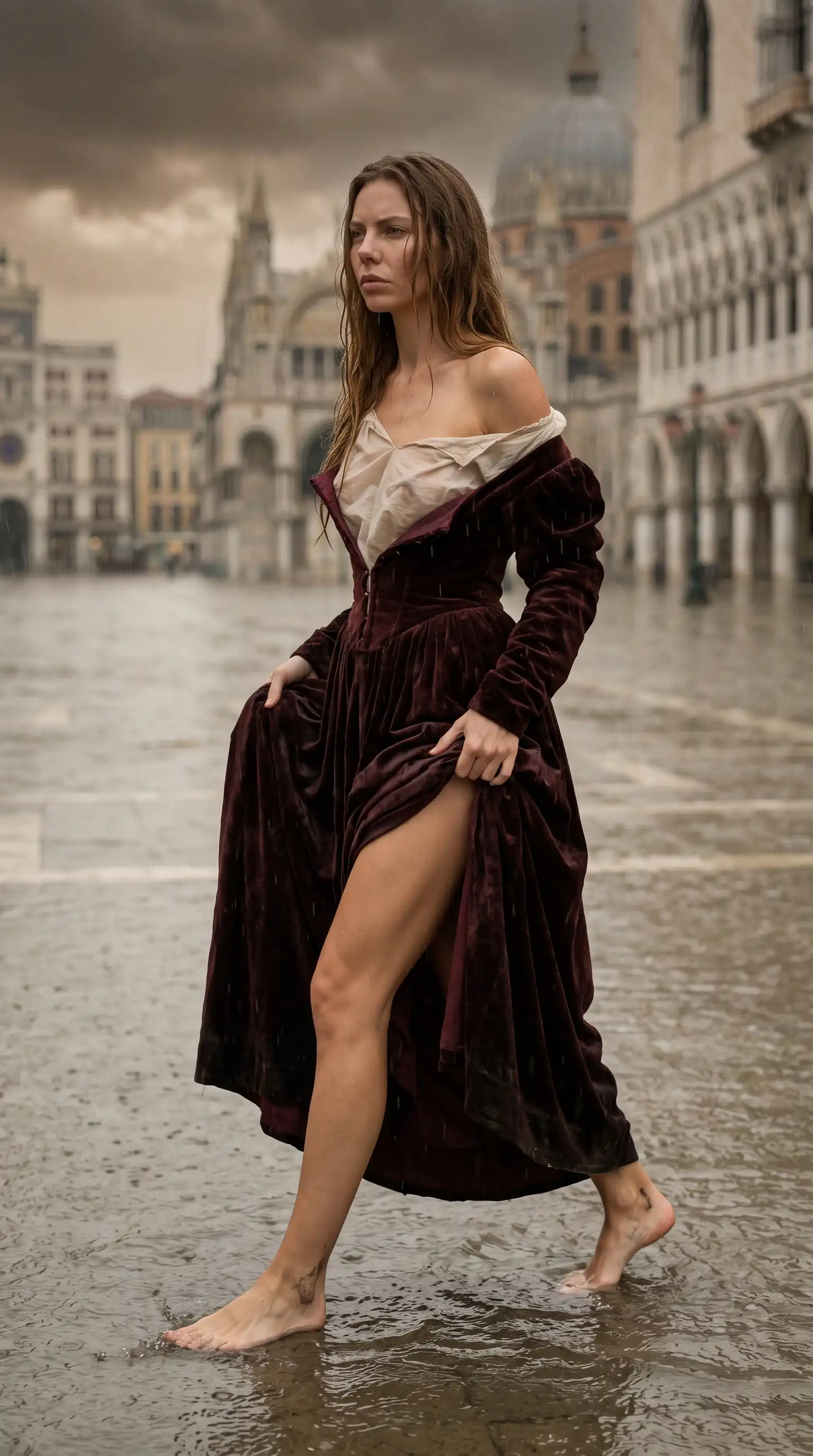
    "concept": "A raw, sensual Renaissance photograph of an affluent Venetian cortigiana onesta walking barefoot across the flooded Piazza San Marco at gloomy autumn dawn after a humiliating night at the Doge's Palace.",
    "historical_context": "Late Renaissance Venice, during the sixteenth century. Cold autumn weather, acqua alta, steady rain, and a nearly deserted square beneath heavy storm clouds.",
    "action": "An adult Venetian courtesan walks briskly but carefully through shallow floodwater covering the stone paving. Both hands gather and lift the hem of her magnificent, rain-soaked burgundy velvet gown. One hand raises the skirt considerably higher than the other, exposing one bare thigh. She has hurriedly thrown the gown back on after her night at the palace, barely fastening it. One shoulder remains exposed, the neckline of the outer gown hangs open, and the wet linen chemise underneath has slipped unevenly across her upper chest. Her soaked clothing, disordered hair, and irritated expression reveal her exhaustion and anger.",
    "narrative": "After a long night among Venice's privileged elite, she has been dismissed and is returning home alone. Her expensive garments are drenched, her appearance has lost its evening refinement, and she is cold, exhausted, and furious. She moves across the empty square with short, impatient steps, retaining her pride despite the indignity.",
    "visual_contrast": "The richness of her Renaissance clothing clashes with her muddy bare feet, exposed shoulder, hastily adjusted gown, and the oppressive grandeur of the flooded piazza beneath a dark storm sky."
  },
  "composition": {
    "framing": "A medium-full environmental portrait showing the woman from head to bare feet, with enough surrounding architecture and flooded paving to establish Piazza San Marco.",
    "camera_position": "A slightly oblique side view, approximately 20–30 degrees away from a perfect profile. A small portion of the front of her torso and face remains visible.",
    "viewing_angle": "An observational, candid viewpoint, as though the photographer has captured her passing through the rain.",
    "subject_placement": "The woman occupies the foreground and moves across the frame. A modest amount of space remains ahead of her direction of travel.",
    "body_orientation": "Her torso follows the direction of her walk. Her face turns slightly forward, creating a readable partial profile rather than a full three-quarter fashion pose.",
    "arm_positions": "Both hands grasp separate sections of the heavy gown. One gathers the hem around knee-to-mid-thigh height, while the other lifts it markedly higher, revealing one bare thigh. Both hands remain clearly separated and anatomically plausible.",
    "gown_shape": "The raised velvet forms an asymmetrical diagonal across the lower frame. The wet skirt gathers into dense folds around her hands, while the loosely worn bodice hangs unevenly across her upper body.",
    "front_opening": "The velvet bodice is incompletely fastened and visibly parted at the front. Its neckline sits unevenly, with one shoulder exposed and the opposite shoulder still partly covered by the garment. The dress looks hastily put on rather than deliberately unfastened for display.",
    "visual_hierarchy": [
      "Her exhausted, irritated face in partial profile",
      "The exposed shoulder and disordered neckline",
      "The damp linen chemise beneath the loosely fastened velvet bodice",
      "Both hands lifting the skirt to different heights",
      "The exposed thigh and muddy bare feet",
      "The flooded Piazza San Marco and blurred Doge's Palace beneath the stormy sky"
    ],
    "background_depth": "Historic architecture recedes into rain-softened atmospheric haze. Wet stone, shallow water, and muted reflections reinforce the damp environment.",
    "photographic_impression": "A candid, imperfect historical photograph captured during an uncomfortable journey home, not a polished fashion campaign."
  },
  "subject": {
    "identity": "An adult Venetian cortigiana onesta, a high-status courtesan accustomed to expensive clothing, cultivated company, and influential patrons.",
    "condition": "Cold, exhausted, rain-soaked, and visibly disheveled after a long and unpleasant night.",
    "expression": "Defiant and irritated, with a slightly tense brow, pressed lips, and a resentful gaze directed along her path.",
    "gaze": "She looks ahead rather than posing for the camera. Her partial profile remains clear and expressive.",
    "body_language": "Her shoulders are slightly hunched against the cold, but her chin remains raised. Her forward movement communicates impatience rather than panic.",
    "movement": "Captured mid-step during a brisk, controlled walk. Her strides are short and natural, with her feet landing relatively close together. She carefully places each foot on the slippery paving while maintaining her balance and holding the heavy skirt.",
    "hair": "Her elaborate evening hairstyle has come undone. Loose, rain-darkened strands hang irregularly around her face, neck, and shoulders, with several damp strands clinging naturally to her cheek.",
    "hands": "Both hands firmly gather separate portions of the wet skirt. Natural wrist angles, believable grip, and clear separation between the hands.",
    "characterization": "Her expensive garments still suggest wealth and elevated social status, but the rain and disorder of the night have stripped away her polished public appearance. She is angry at the indignity, not ashamed of herself."
  },
  "wardrobe": {
    "outer_gown": {
      "garment": "A magnificent sixteenth-century Venetian velvet gown appropriate to an exceptionally wealthy courtesan.",
      "material": "Deep wine-red and dark burgundy silk velvet with a rich pile, subtle natural sheen, and gold-thread embroidery.",
      "ornamentation": "Restrained golden botanical embroidery and decorative trim, visible in selected areas despite the rain.",
      "construction": "A fitted Renaissance bodice with a front opening secured by historically inspired ties or concealed period fastenings. No modern zipper or contemporary garment construction.",
      "dressing_state": "The gown has been hastily thrown back on after the night at the palace. It has not been properly adjusted or fastened. The front remains partly open, the bodice sits unevenly, and one side has slipped off a shoulder.",
      "shoulder_and_sleeve": "One shoulder is clearly bare. The corresponding side of the bodice and sleeve has slipped downward, while the opposite shoulder remains partly covered. The garment is still worn over the body rather than completely removed.",
      "front_opening": "The two front edges of the velvet bodice remain loosely parted over the linen chemise. The neckline is crooked and asymmetrical, with an obvious sense of hurried dressing and little concern for neatness.",
      "wetness": "The gown is thoroughly wet from rain and floodwater. The velvet darkens unevenly, absorbs much of the light, and forms heavy, saturated folds. Rain droplets collect on its upper surfaces.",
      "hem_lifting": "Both hands gather the skirt at different heights. One section is lifted around knee-to-mid-thigh height, while the other is raised significantly higher, exposing one bare thigh.",
      "fabric_physics": "The gathered skirt forms dense folds around the hands. The remaining wet fabric hangs heavily and shifts modestly with each short step. The bodice and slipped sleeve also respond naturally to the woman's movement and gravity.",
      "movement": "The heavy skirt sways and settles with each step. The loose bodice moves slightly as she walks, but the exposed shoulder remains visible throughout the frame.",
      "visual_character": "The gown remains recognizably expensive, yet its wetness, incomplete fastening, slipped shoulder, and awkwardly lifted hem make it look uncomfortable and hastily adjusted."
    },
    "chemise": {
      "historical_name": "A fine Renaissance linen chemise, the soft undergarment worn beneath the outer gown.",
      "material": "Light natural linen with a fine weave, understated embroidered edging, and a supple drape.",
      "condition": "Thoroughly damp from rain, creased, and displaced after a long night and hurried dressing.",
      "neckline": "The chemise sits unevenly across the collarbones and upper chest. Its neckline has slipped down over the exposed shoulder while remaining higher on the opposite side, creating a naturally asymmetrical opening.",
      "bodice_interaction": "The incompletely fastened velvet bodice frames the chemise irregularly. The contrast between the parted outer gown and the damp undergarment is clearly visible.",
      "wet_fabric_behavior": "The soaked linen clings closely across the chest and upper torso, following the natural contours of the body. Small damp folds and areas of fabric tension appear beneath the neckline and across the chest.",
      "opacity": "The chemise remains opaque despite being wet. It follows the chest's contours through contact and tension without becoming transparent. The breasts remain covered.",
      "surface_detail": "Rain droplets, damp patches, and irregular creases give the linen a visibly wet, lived-in quality.",
      "visual_effect": "A damp linen chemise beneath a hastily worn velvet gown creates an impression of disordered elegance. The exposed shoulder, uneven neckline, and fabric clinging to the body are integral to the scene rather than exaggerated erotic details.",
      "historical_character": "The garment reads clearly as a Renaissance linen chemise, not a modern blouse, camisole, or contemporary bra."
    },
    "legwear_and_feet": {
      "stockings": "No visible stockings. Her legs and feet are bare.",
      "legs": "One bare thigh is clearly visible where the higher section of the gown is gathered. The other leg emerges naturally beneath the raised hem.",
      "skin_and_moisture": "Rainwater beads along the lower legs. Small irregular streaks of watery grime and fine sediment remain around the ankles and calves.",
      "feet": "Bare feet dampened by cold floodwater, with subtle dark grit, thin muddy residue, and wet stone marks around the soles and toes.",
      "foot_contact": "Her feet make careful contact with slippery paving. Toes flex naturally for balance, and small ripples spread around each step.",
      "physical_realism": "Water and grime follow the natural contours of the feet and legs. Avoid perfectly clean soles, uniformly applied mud, or a heavy coating of dirt."
    },
    "overall_appearance": "Expensive Renaissance clothing worn in disarray: rain-soaked burgundy velvet, an incompletely fastened front bodice, one exposed shoulder, a slipped and damp linen chemise, disordered wet hair, an asymmetrically raised hem, bare legs, and muddy wet feet. She looks as though she hurriedly dressed and left the palace without taking time to arrange herself properly."
  },
  "environment": {
    "location": "Piazza San Marco, Venice, during the late Renaissance.",
    "time": "Early autumn dawn beneath a heavy, dark storm sky.",
    "season": "Late autumn, during cold, damp weather associated with acqua alta.",
    "sky": "A vast leaden storm sky with thick layered clouds. Its color is warm gray, taupe, muted olive-gray, and dirty sepia rather than clean blue. The cloud cover is dense and oppressive, with weak diffuse light filtering through.",
    "rain": "Noticeable, persistent light-to-moderate rain. Fine streaks cross the frame, and droplets collect on the woman's hair, shoulders, and garments. The rain is clear enough to explain her soaked condition but never becomes a torrential downpour.",
    "floodwater": "Shallow lagoon water covers sections of the stone paving. Rain rings, overlapping ripples, and small splashes form around her feet.",
    "architecture": "The Gothic exterior and distinctive arcades of the Doge's Palace remain recognizable in the background, with historically appropriate stonework.",
    "square": "The piazza is nearly deserted. Its broad open space and monumental architecture emphasize her solitude.",
    "ground": "Wet stone paving with darkened joints, shallow reflective water, subtle sediment, and irregular muddy residue washed across the surface.",
    "historical_authenticity": "Renaissance-era architecture, stonework, costume, and surroundings. No modern flood barriers, contemporary signage, street furniture, or present-day tourist infrastructure.",
    "atmosphere": "A cold, oppressive, rain-soaked public square that feels deserted and indifferent to the woman's private humiliation."
  },
  "lighting": {
    "style": "Dim natural dawn light under heavy storm clouds, rendered with the warm, muted tonal response of aged color film.",
    "source": "Diffuse daylight filtered through dense storm clouds and rain. No artificial illumination.",
    "intensity": "Low and subdued, as though dawn has barely broken. The scene must not look brightly exposed or commercially lit.",
    "locked_color_palette": {
      "storm_sky": "Warm lead-gray, taupe, muted olive-gray, and dirty sepia.",
      "velvet": "Deep burgundy, dark wine red, and blackened crimson.",
      "stone_and_water": "Weathered beige-gray, muddy taupe, muted brown-gray, and dirty silver.",
      "skin": "Natural warm-neutral beige with restrained, subdued highlights.",
      "shadows": "Warm charcoal, dark umber, and softened near-black.",
      "highlights": "Subtle faded ochre and muted amber, never bright orange or golden sunlight."
    },
    "on_subject": "Soft, low-contrast illumination reveals her partial profile, exposed shoulder, loosely worn bodice, damp linen, and rain-darkened hair without creating crisp modern beauty lighting.",
    "chemise": "The wet linen retains enough diffuse tonal detail to show its wrinkles and close contact across the chest while remaining naturally opaque.",
    "wet_fabric": "Muted reflections reveal the saturated velvet and linen. Highlights remain soft and subdued rather than bright or glossy.",
    "rain_visibility": "Fine, restrained rain streaks and droplets become visible against dark garments and architecture. No bright white streaks or artificially sharpened rain.",
    "background": "The Doge's Palace is rendered in warm weathered gray and taupe, softened by atmospheric haze and reduced contrast.",
    "water": "Broken reflections of the storm sky and stone architecture in muted gray-brown, beige-gray, and dirty silver. Avoid vivid blue water.",
    "contrast": "Moderate, atmospheric contrast with softened highlight roll-off, gently faded blacks, and sufficient shadow detail to retain texture.",
    "highlight_control": "Muted highlights, subdued reflections, and a consistent aged-film tonal response throughout the entire image.",
    "avoid": [
      "Bright blue sky",
      "Clean cool-blue color grading",
      "Golden sunrise",
      "Orange cinematic lighting",
      "Warm romantic sunlight",
      "Bright midday illumination",
      "Direct camera flash",
      "Studio lighting",
      "Strong artificial fill",
      "Overexposed skin or wet fabric",
      "Bright white rain streaks",
      "Clinical digital contrast",
      "Excessive HDR",
      "Perfectly clean commercial exposure"
    ]
  },
  "motion_and_camera_effects": {
    "movement_priority": "A brisk but measured walk through cold rain. She is eager to get home, but she is not running.",
    "stride": "Short, quick, natural steps with modest leg separation. Her feet are carefully placed on slippery stones; avoid exaggerated leg extension or dramatic lunging.",
    "body_motion": "A slight forward lean, natural shifting of weight, and mild rotation through the shoulders and hips.",
    "fabric_motion": "The wet skirt sways gently with each step. The loosely worn bodice and slipped sleeve move subtly with her stride without changing the established exposed-shoulder arrangement.",
    "hair_motion": "Rain-heavy strands move slightly with her steps and cling irregularly to her cheek, neck, and shoulders.",
    "water_motion": "Small ripples and restrained splashes form around her feet, consistent with short steps through shallow water.",
    "rain_motion": "Fine rain streaks angle slightly across the frame, indicating a weak breeze. Rain does not obscure the woman or the architecture.",
    "motion_blur": "Minimal directional motion blur around the lower hem, feet, and a few loose strands. The subject remains clearly recognizable.",
    "face_clarity": "Keep her partial profile, eyes, and expression readable. Avoid motion blur across the face.",
    "camera_feeling": "A candid handheld exposure with slightly imperfect timing, softened detail, and the natural limitations of an older photographic process."
  },
  "textures_and_physical_detail": {
    "velvet": "Visible pile, darkened wet patches, flattened sections, and dense folds in saturated burgundy fabric.",
    "linen": "Fine weave, irregular creases, darkened damp patches, a loosely displaced neckline, and natural fabric tension across the chest.",
    "embroidery": "Subtle gold-thread details, muted by rain and subdued exposure.",
    "rain": "Fine droplets on hair, shoulders, sleeves, and the gown, with understated streaks visible against darker surfaces.",
    "water": "Shallow ripples, small splashes, rain rings, broken reflections, and wet stone texture.",
    "ground_grime": "Thin traces of dark sediment and muddy residue on paving, soles, toes, and lower legs.",
    "feet": "Wet skin, subtle traces of grit, and uneven darkening around the soles and toes.",
    "skin": "Natural texture and subtle signs of cold, expressed through posture and movement rather than exaggerated redness.",
    "film_surface": "Strong organic film grain, subtle color grain, gently softened microcontrast, and slight tonal irregularity across the frame.",
    "rendering": "Tactile, imperfect realism. Prioritize believable fabric construction, moisture, and aged photographic character over modern digital sharpness."
  },
  "photographic_style": {
    "genre": "Raw historical editorial photography with the character of an aged analogue color photograph.",
    "aesthetic": "Aged 35mm color film, warm muted tones, visible organic grain, softened detail, faded blacks, and imperfect photographic rendering.",
    "camera_angle": "A slightly oblique side view, closer to profile than to a three-quarter portrait.",
    "camera_timing": "Captured mid-step during a brisk but measured walk.",
    "focus": "Her partial profile, exposed shoulder, loosely worn gown, damp chemise, raised hem, and muddy feet remain readable. The architecture is recognizable but softly blurred.",
    "depth_of_field": "Moderately shallow, without exaggerated modern portrait bokeh or razor-sharp separation.",
    "film_grain": "Strong, clearly visible organic 35mm color-film grain throughout the image, especially in the storm clouds, shadowed gown, and darker architectural areas. Grain should resemble analogue emulsion rather than uniform digital noise.",
    "film_age": "A slightly aged color negative or print with a consistent warm cast, mild fading, softened blacks, restrained saturation, and subtle imperfections.",
    "tonal_response": "Soft highlight roll-off, slightly lifted black points, imperfect shadow separation, and subdued midtone contrast. Preserve enough detail to read the face, linen, velvet, and architecture.",
    "color_grading": "Match the established reference palette: warm dirty-sepia grays in the sky, weathered beige and taupe stone, dark burgundy velvet, muted warm-neutral skin, and muddy gray-brown water.",
    "optical_character": "Slightly softened fine detail, restrained edge sharpness, subtle halation around the palest reflections, and believable low-light imperfections.",
    "finish": "Rough, atmospheric, grainy, warm, and gloomy. The image should resemble a weathered historical color photograph rather than a fresh image from a modern mirrorless camera."
  },
  "mood_and_story": {
    "mood": [
      "Defiant",
      "Exhausted",
      "Sensual",
      "Cold",
      "Humiliated",
      "Impatient",
      "Gloomy"
    ],
    "emotional_tone": "She is cold, angry, and tired of being treated as disposable by people who welcomed her company only hours earlier. Her short, brisk steps communicate impatience and a desire to leave.",
    "erotic_subtext": "The sensuality comes from the exposed shoulder, the incompletely fastened velvet gown, the damp chemise following the chest's natural contours while remaining opaque, the bare thigh, and the contrast between luxury and disarray.",
    "social_subtext": "Her expensive clothing reveals her standing, while her muddy bare feet and hastily adjusted appearance contrast with the privileged world she has just left.",
    "visual_story": "The monumental architecture remains behind her as she moves away from the palace through shallow floodwater and rain. Her loosened gown, dark sky, and solitary figure reinforce the sense of an unpleasant journey home.",
    "character": "She is visibly upset and exhausted, but her posture retains a stubborn trace of pride. She wants to get home, not perform for an audience.",
    "photographic_mood": "Warm, dirty, subdued color and strong aged-film grain make the scene feel like a forgotten photograph: intimate, uncomfortable, gloomy, and emotionally raw."
  },
  "final_goal": "Create a raw, sensual Renaissance-era photograph of an adult Venetian cortigiana onesta walking barefoot across the flooded Piazza San Marco at gloomy autumn dawn after a humiliating night at the Doge's Palace. Preserve the established reference palette: warm dirty-sepia storm clouds, weathered beige-gray architecture, muted taupe water, deep burgundy velvet, subdued warm-neutral skin, warm charcoal shadows, and faded highlights. Use persistent, noticeable but moderate rain beneath a heavy leaden sky. Photograph her from a slightly oblique side angle, closer to profile than to a three-quarter portrait. Both hands lift the velvet skirt to different heights, with one section pulled considerably higher to reveal a bare thigh. Her gown has been hurriedly thrown back on rather than properly dressed: the front bodice remains incompletely fastened and loosely parted, one shoulder is clearly exposed, and the opposite shoulder remains partly covered. Beneath it, a fine Renaissance linen chemise has slipped unevenly off the exposed shoulder and sits crookedly across the upper chest. The soaked linen clings closely to the chest, naturally following its contours while remaining opaque and covering the breasts. The overall clothing arrangement should resemble someone who dressed quickly and left without taking time to straighten or fasten anything. Her expression is exhausted, irritated, and defiant. Her bare feet and lower legs show subtle wet grime and fine muddy residue from the flooded paving. Give her short, quick, controlled steps rather than long lunges or a running gait. Include small ripples, restrained splashes, naturally moving fabric, and minimal motion blur. Keep her face readable, anatomy coherent, and the Doge's Palace recognizable but blurred behind her. Apply strong organic 35mm film grain, subtle color grain, softened microcontrast, gently faded blacks, restrained saturation, and subtle analogue ageing. Eliminate the crisp, clinical contrast and polished clarity of a modern digital camera. The finished image should match the reference's warm, gloomy, weathered photographic palette and capture a proud, high-status woman making a hurried, uncomfortable journey home in the aftermath of a humiliating night.",
  "negative_prompt": "clothes, underwear, bra, panties, swimsuit, explicit nudity, visible nipples, exposed intimate anatomy, transparent fabric revealing breasts, modern blouse, modern bra, modern zipper, modern clothing, modern shoes, high heels, stockings in hand, modern hair styling, fully buttoned bodice, perfectly fastened gown, neatly arranged neckline, both shoulders symmetrically covered, perfectly styled outfit, electric lighting, bright blue sky, clean cool-blue grading, golden sunrise, orange cinematic lighting, warm romantic sunlight, bright midday sun, studio lighting, camera flash, glossy fashion campaign, posed standing portrait, frontal camera angle, full three-quarter fashion pose, symmetrical arms, both hands lifting the hem to the same height, hidden thigh, stiff static skirt, frozen walking pose, running, sprinting, oversized strides, exaggerated leg extension, excessive motion blur, blurred face, hidden eyes, distorted limbs, extra arms, extra hands, malformed fingers, duplicated legs, ghosted body parts, impossible gait, unnatural fabric behavior, exaggerated cleavage, artificial wet-look gloss, immaculate dry clothing, perfectly clean bare feet, uniformly applied mud, thick mud coating, excessive dirt, heavy torrential rain, dense sheets of rain, rain obscuring the face, storm-force wind, dramatic water sprays, modern Piazza San Marco, modern flood barriers, tourists, contemporary signage, vehicles, fantasy architecture, fresh digital-camera look, modern mirrorless-camera clarity, razor-sharp details, clinical microcontrast, excessive HDR, overprocessed clarity, glossy photorealistic finish, clean digital gradients, oversaturated colors, excessive orange filter, monochrome sepia, uniform digital noise, coarse pixel noise obscuring the subject, text, captions, logos, watermarks, UI elements"
}
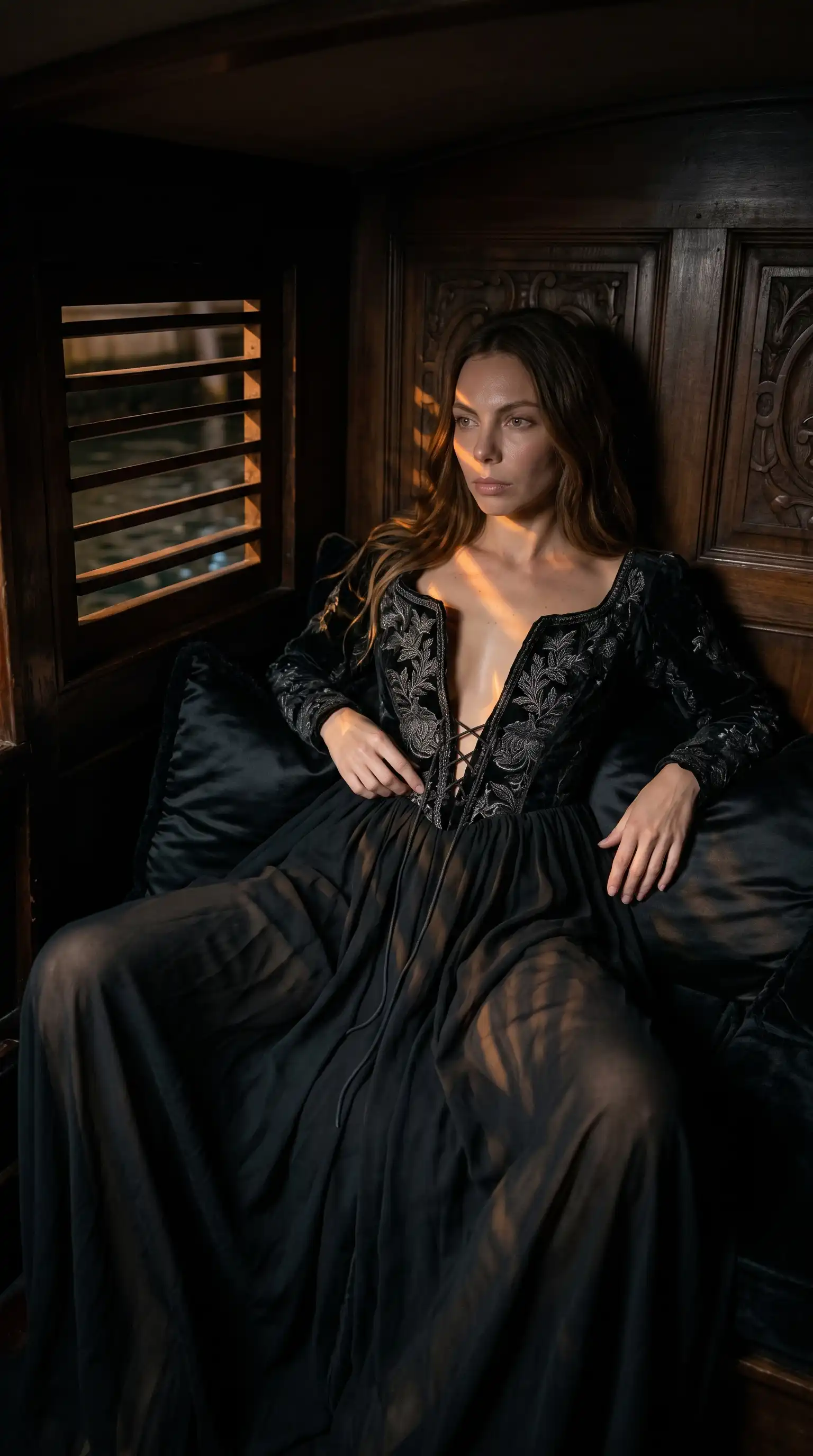
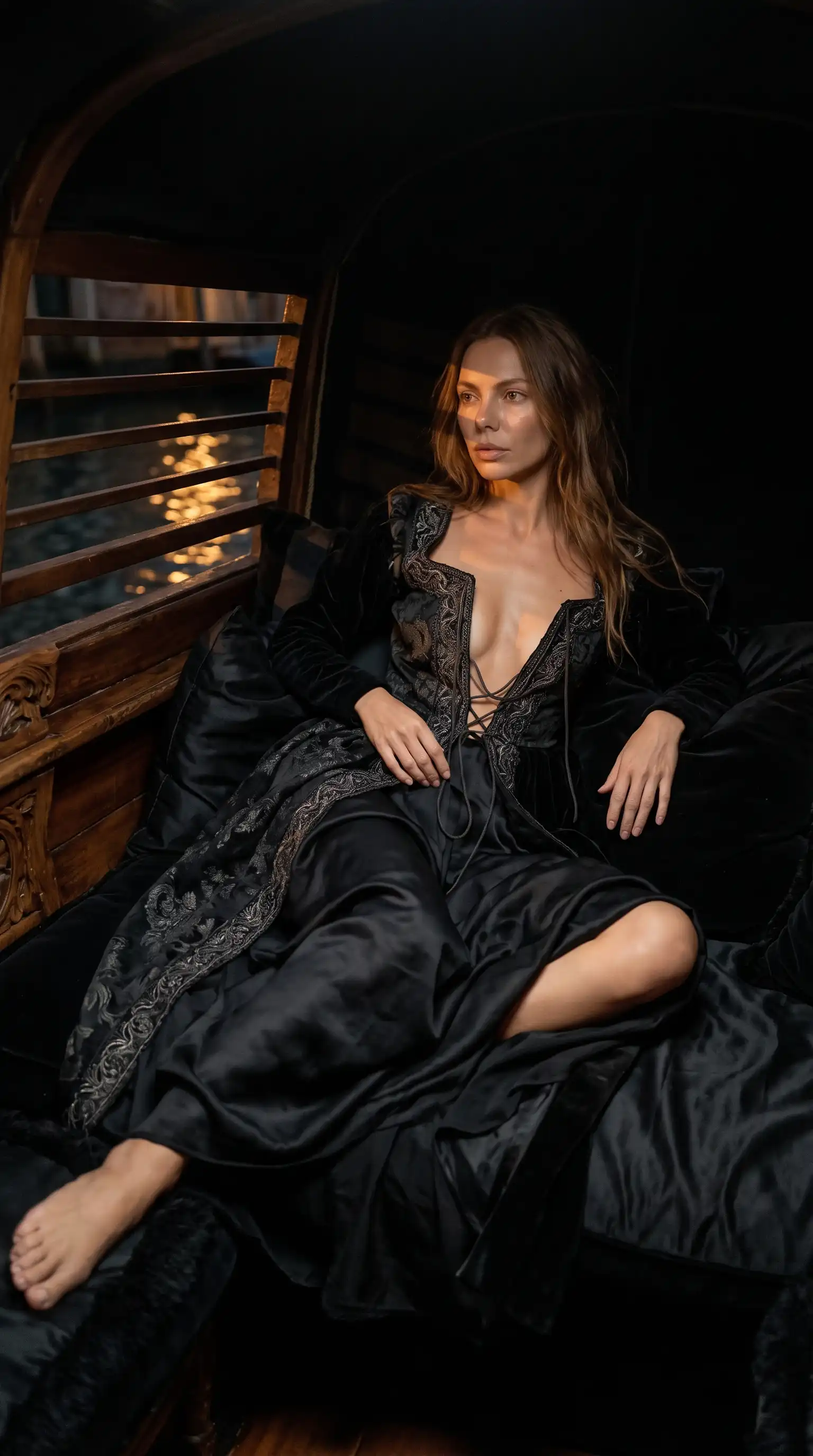
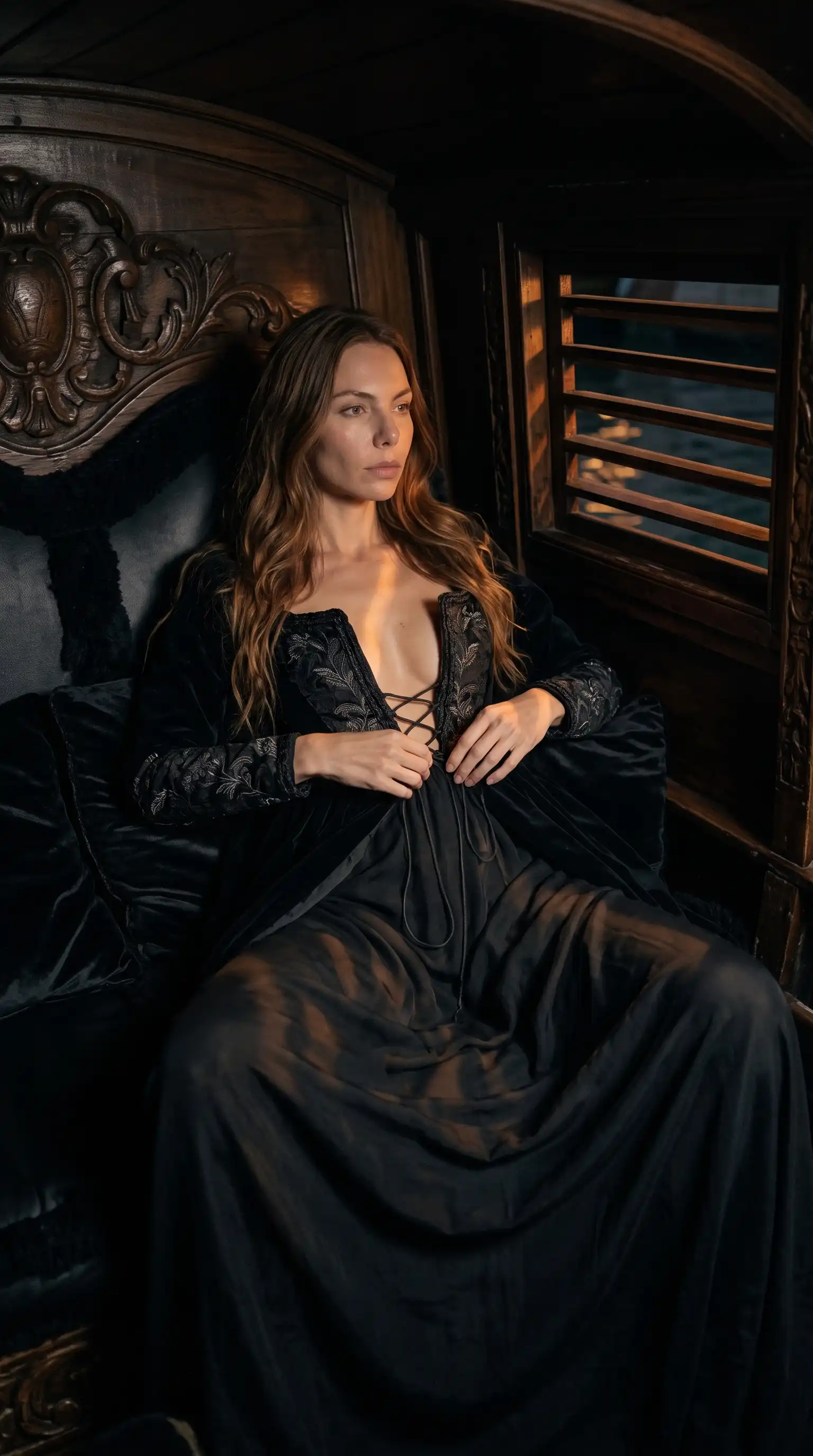
PROMPT
{
  "core_scene": {
    "concept": "An intimate, sensual Renaissance scene inside the luxurious private cabin of a Venetian gondola at night.",
    "historical_context": "Sixteenth-century Venice. A wealthy Venetian cortigiana onesta reclines inside a private gondola cabin, known as a felze, while the vessel moves quietly along a dark canal.",
    "action": "An adult Venetian courtesan reclines diagonally against luxurious black silk cushions in the nearly dark wooden cabin. She has loosened the front lacing of her expensive black gown herself. The lacing hangs slack, the bodice edges have fallen apart, and the neckline opens into an exceptionally deep V, revealing an elongated strip of bare skin down the center of her chest. She wears no chemise or underdress beneath the gown. The loosened garment rests directly against her body, following her reclining posture naturally. Her thin silk skirt settles over her lap and separately positioned legs, following their relaxed, deliberately open posture in soft folds.",
    "narrative": "The private journey has become a secluded encounter. The woman has deliberately loosened her gown and settled comfortably into the cushions. She appears composed, serious, and ready for intimacy, surrounded by expensive materials and almost total darkness.",
    "emotional_focus": "The stillness before intimacy: confidence, anticipation, and sensual tension expressed through the relaxed pose, the loosened bodice, the soft fabric over her legs, and sharply divided light and shadow."
  },
  "composition": {
    "framing": "An intimate medium shot wide enough to include the woman's face, shoulders, upper torso, hands, hips, and the position of both thighs and knees beneath the skirt.",
    "camera_position": "A close viewpoint from slightly above and to one side of the reclining subject. The angle feels private and observational, never like a formal fashion portrait.",
    "subject_placement": "The woman reclines diagonally against black silk cushions and occupies most of the visible frame. Dark carved wood encloses the scene.",
    "body_orientation": "Her torso rests at a relaxed angle, with her shoulders settled into the cushions. Her head turns slightly toward the side rather than being aligned directly with the camera.",
    "gaze": "Her eyes may be directed toward the dark window or an unseen companion beside the camera. Direct eye contact is not required.",
    "expression": "Serious, composed, and contemplative. Her lips rest naturally, with no smile or playful expression.",
    "hands": "One hand rests near the loose front lacing of the bodice, lightly holding one edge of the garment. The other rests naturally on the gown or cushion. Both hands have simple, physically plausible positions.",
    "leg_pose": "Her legs are distinctly spread apart in a relaxed, deliberately inviting reclining posture. Both thighs angle outward, creating a clear separation between the knees. Each leg rests independently along the cushions, with natural asymmetry in the position of the knees and feet. Neither leg crosses over the other, and the thighs do not press together.",
    "leg_geometry": "The pelvis remains comfortably supported by the cushions. Both hips are positioned naturally, with the knees separated enough for the open pose to be immediately readable. Avoid a crossed-leg, ankle-over-ankle, or tightly closed-leg position.",
    "skirt_composition": "The thin black silk skirt drapes over the separately positioned thighs. The fabric forms distinct folds along the outside of each leg, with a visible central separation in the silhouette. The drape follows the open reclining pose instead of pulling the legs together or hiding the position of the knees.",
    "visual_hierarchy": [
      "Her serious expression, partially illuminated by the window light",
      "The substantially loosened black bodice and ultra-deep V-shaped neckline",
      "The narrow strip of exposed skin at the center of the chest",
      "The separated knees and relaxed, open leg posture beneath the thin black silk skirt",
      "The restrained dark-silver embroidery",
      "The striped window light across black silk cushions and carved wood"
    ],
    "depth": "The woman's face, hands, and upper garment occupy the principal focus plane. Her skirt, separated thighs, and cushions remain readable in the same intimate composition, while the walls and corners of the cabin disappear into darkness.",
    "spatial_intimacy": "The low ceiling, enclosed wooden walls, and minimal visible surroundings create the feeling of an exceptionally private space.",
    "visual_restraint": "Keep the composition concentrated on the woman and the immediate cabin interior. Avoid wide cabin views, unnecessary decorative objects, or a visible companion."
  },
  "subject": {
    "identity": "An adult Venetian cortigiana onesta, a wealthy, educated, and socially accomplished woman accustomed to private meetings with influential patrons.",
    "pose": "Reclining comfortably and diagonally against black silk cushions. Her upper body is supported at a gentle angle, her shoulders are relaxed, her hips are settled into the seat, and both legs extend separately with the knees clearly apart.",
    "body_language": "Relaxed and self-possessed, conveying deliberate anticipation rather than anxiety or physical discomfort. Her open posture feels natural and unreserved rather than rigidly posed.",
    "expression": "Serious, quiet, and slightly pensive. No smile, laughter, or theatrical expression.",
    "gaze": "Directed away from the camera toward the window or an unseen companion. Her attention feels personal and inward rather than performative.",
    "breathing": "Natural, subtle movement suggested by her relaxed shoulders and the way the gown rests against her torso.",
    "hands_and_action": "She has loosened the bodice herself. One hand rests near the slack lacing while the other lies naturally on the fabric or cushion.",
    "hair_and_styling": "Her evening hairstyle is slightly softened by the private journey. The styling remains elegant but no longer perfectly formal.",
    "leg_position": "Both knees are distinctly separated, with the thighs angled outward and each leg resting independently. The pose is openly inviting without requiring exaggerated joint angles or unnatural hip rotation.",
    "characterization": "She is confident and comfortable in the luxurious private world she inhabits. Her sensuality comes from her ease, self-possession, deliberately loosened clothing, and unreserved posture rather than exaggerated posing."
  },
  "wardrobe": {
    "outer_gown": {
      "garment": "An exceptionally luxurious late Renaissance Venetian gown appropriate to a wealthy woman of the sixteenth century.",
      "overall_color": "Deep black with subtle tonal variation between black velvet, black silk, and near-black brocade.",
      "bodice_material": "Rich black silk velvet and dark brocade with a dense, tactile surface.",
      "skirt_material": "Fine, lightweight black silk with a supple, fluid drape. The skirt is visibly lighter in construction than the fitted bodice.",
      "ornamentation": "Intricate but restrained embroidery in dark silver, graphite, and muted gunmetal thread. The ornament is low-contrast and becomes visible only where narrow window-light bands graze the fabric.",
      "embroidery_character": "Fine botanical scrollwork and delicate Renaissance-inspired motifs, almost disappearing into the black material in shadow. Avoid bright silver, sparkling metallic thread, or patterns that dominate the image.",
      "construction": "A fitted Renaissance-inspired bodice with visible front lacing, historically plausible seams, and carefully tailored panels.",
      "condition": "The gown is intact and luxurious but deliberately loosened at the front. The upper bodice no longer fits tightly across the chest.",
      "front_opening": "The front lacing is substantially undone. The cords hang loosely, the two bodice edges have separated, and the neckline has fallen into a pronounced, elongated V shape.",
      "bodice_fit": "The loosened bodice no longer rigidly supports or compresses the chest. Its upper edges rest loosely against the body and respond naturally to the reclining position.",
      "skirt_construction": "The skirt is made from a single lightweight layer of fine black silk, with no visible petticoat or bulky underskirt. Its fluid construction allows it to settle naturally over the woman's lap and separately positioned legs.",
      "skirt_behavior": "The thin silk falls softly over her thighs and forms distinct folds along the outside of each leg. Its contour reveals the general arrangement of her open reclining pose through light, shadow, and fabric tension without becoming transparent.",
      "leg_separation": "The skirt drapes over two clearly separated thighs. Its central folds follow the space between the legs rather than concealing the separation or visually joining the thighs together.",
      "fabric_tension": "The skirt falls loosely across the thighs and forms shallow tension lines where it rests against the body and cushions. Avoid pulling the fabric tightly enough to create an unnatural, stretched silhouette.",
      "draping": "The skirt gathers across the lap and trails over the cushions in flowing diagonal folds, following the reclining posture and the separate placement of each leg.",
      "visual_character": "Understated luxury through black-on-black materials, dark-silver ornament, precise tailoring, and the contrast between a structured bodice and fluid, lightweight skirt."
    },
    "corset_and_bodice": {
      "construction": "A fitted Renaissance bodice with visible front lacing integrated into the gown. Avoid modern lingerie construction, contemporary underwire cups, or a modern corset design.",
      "lacing": "The front lacing is very loose, with slack crossed cords and clearly separated bodice edges. It is visibly undone rather than merely decorative.",
      "neckline": "An ultra-deep V-shaped neckline formed by the loosened front edges of the gown and emphasized by the reclining pose.",
      "exposed_skin": "A narrow, elongated area of bare skin is visible down the center of the chest. The opening follows the natural shape of the garment rather than resembling a geometric cutout.",
      "gravity_and_pose": "The neckline naturally deepens as the woman reclines against the cushions. The fabric rests according to gravity, with slight asymmetry between the two sides of the bodice.",
      "support_and_fit": "The garment is visibly relaxed and no longer tightly holds the chest in place. Its edges rest loosely against the body, with realistic tension and folds around the lacing.",
      "visual_effect": "Intimate and strongly sensual, with the deep neckline and exposed central strip of skin remaining the main upper-body detail."
    },
    "underlayers": {
      "chemise": "None. No linen chemise, underdress, blouse, petticoat, or separate garment is worn beneath the gown.",
      "bodice_contact": "The inside of the loosened bodice rests directly against the woman's skin wherever the garment touches her torso.",
      "skirt_layers": "One fine outer skirt layer, with no bulky underskirt or petticoat.",
      "visual_continuity": "The deep neckline reveals a continuous area of skin between the separated bodice edges. The thin skirt remains dark and sufficiently opaque, allowing the open position of her legs to be understood through folds and shadows."
    },
    "color_palette": "Nearly black silk and velvet, dark charcoal, graphite-silver embroidery, black silk cushions, aged walnut, and restrained warm amber highlights."
  },
  "gondola_cabin": {
    "location": "Inside the private felze of an elegant Venetian gondola.",
    "structure": "A compact enclosed cabin with a low curved ceiling, dark wooden framing, carved panels, and narrow slatted windows.",
    "wood": "Very dark aged walnut with visible grain, a subdued finish, worn edges, and carved Renaissance ornament that emerges only where light strikes it.",
    "upholstery": "Deep black silk cushions with subtle woven texture, soft creases, and occasional narrow reflections.",
    "textiles": "Black velvet and dark brocade details that complement the gown without introducing bright contrasting colors.",
    "window": "A small window fitted with horizontal wooden slats. Beyond it lies the dark Venetian canal, with only faint and intermittent reflections visible.",
    "historical_details": "Period-appropriate joinery, carved wood, rich textiles, and fittings. The interior should feel like a luxurious Renaissance gondola cabin rather than a modern boat or yacht.",
    "atmosphere": "Nearly complete darkness, rich materials, and a feeling of physical closeness. The cabin's shape is suggested by highlights on wood rather than by general illumination."
  },
  "environment": {
    "time": "Night on a quiet Venetian canal.",
    "outside_view": "The canal and city beyond the window are almost entirely dark. Small, broken glimmers of reflected light appear intermittently through the slats.",
    "light_source": "All illumination enters through the cabin windows. Outside, faint torchlight and reflections on the water create warm, moving light that filters through the wooden slats.",
    "water_movement": "Subtle shifting reflections suggest the gondola's slow movement along the canal.",
    "outside_visibility": "No bright skyline or clearly illuminated buildings. The outside world remains a dark, barely visible presence.",
    "privacy": "The enclosed cabin isolates the woman from public Venice. The window is the only visible connection to the outside world.",
    "atmosphere": "Quiet, enclosed, and deeply private, with old timber, black silk, and the faint suggestion of moving water beyond the shutters."
  },
  "lighting": {
    "style": "Extremely low-key chiaroscuro with hard-edged bands of window light and deep, nearly black shadows.",
    "only_source": "All light enters through the small cabin windows. No interior candles, lamps, studio lighting, or frontal fill light.",
    "external_light": "Intermittent warm torchlight from outside, reflected by the canal water and entering through the slatted window.",
    "intensity": "The cabin is almost completely dark. Only narrow areas touched by the window light are clearly visible.",
    "contrast": "Pronounced, dramatic separation between illuminated surfaces and deep shadow. The light should not evenly reveal the entire face, body, or cabin.",
    "slatted_light": "Distinct, narrow bands of warm light pass through the horizontal window slats, crossing selected areas of the woman's face, collarbones, open neckline, skirt, cushions, and carved wood.",
    "pattern_behavior": "The light-and-shadow bands follow the angle and spacing of the slats. They remain geometrically coherent across the surfaces they touch, interrupted naturally by the woman's body and surrounding objects.",
    "on_face": "A narrow band of light partially illuminates her cheek, eye area, or jaw while the rest of her face falls into shadow. Her serious expression remains just readable.",
    "on_chest": "A small, controlled band of warm light traces part of the collarbones and the exposed central strip of skin at the deep neckline. The remainder of the torso remains predominantly shadowed.",
    "on_gown": "Directional highlights reveal the almost-black material and pick out fragments of dark-silver embroidery. The fabric remains predominantly black, with no green or bright metallic cast.",
    "on_skirt": "Narrow window light softly outlines selected folds of the fine black silk. Subtle changes between light and shadow make the separation of the reclining legs readable beneath the fabric without exposing intimate anatomy.",
    "on_wood": "The slatted light creates sharp alternating bands across the dark wooden panels, revealing grain and carved details only in isolated areas.",
    "on_cushions": "The black silk absorbs most of the light, with occasional narrow highlights along folds and edges.",
    "shadow_quality": "Deep, dense shadows with sharp boundaries near the window light and softer transitions where reflected water light diffuses across the interior.",
    "exposure": "Intentionally underexposed. Preserve localized texture and detail while allowing most of the cabin to disappear into darkness.",
    "color_temperature": "Muted amber and old gold from the outside torchlight, balanced by black, charcoal, and deep walnut-brown shadows.",
    "highlight_control": "Small, controlled highlights with no blown skin reflections, bright windows, or large illuminated surfaces.",
    "avoid": [
      "Green or olive cast in the dress",
      "Bright silver embroidery",
      "Bright moonlight filling the cabin",
      "Interior candles",
      "Interior lamps",
      "Even ambient illumination",
      "Bright frontal light",
      "Studio fill",
      "Large bright window opening",
      "Overexposed skin",
      "Glossy modern beauty lighting",
      "Strong lens flare",
      "Excessive glow",
      "HDR shadow recovery",
      "Uniformly visible cabin walls"
    ]
  },
  "textures_and_physical_detail": {
    "velvet": "Nearly black silk velvet with subtle directional sheen, visible pile, and deep shadows.",
    "skirt": "Fine black silk in a single lightweight layer, with fluid folds, soft contour changes, and realistic shadowing over the separate reclining legs.",
    "embroidery": "Intricate, low-contrast dark-silver and graphite stitching that becomes visible only where window light grazes the surface.",
    "skin": "Natural surface texture with selective warm highlights and substantial areas left in shadow.",
    "wood": "Dark walnut grain, carved details, fine wear, and small reflective areas where the window light strikes.",
    "black_silk": "Softly reflective black upholstery with restrained sheen and irregular folds.",
    "lacing": "Slack dark cords, loosened knots, and subtle tension where the garment panels remain connected.",
    "light_and_shadow": "Distinct slatted-light patterns across the woman and cabin, with sharp transitions and naturally dark unlit surfaces.",
    "film_texture": "Visible organic 35mm film grain, especially in the deep shadows, black skirt, and wooden interior. The grain should feel analogue rather than like uniform digital noise.",
    "rendering": "High tactile detail in locally illuminated areas, while preserving near-black shadows and soft optical transitions."
  },
  "photographic_style": {
    "genre": "Historical fine-art photography with intimate sensual editorial framing.",
    "visual_language": "Dark Renaissance-inspired realism, dramatic chiaroscuro, and low-light analogue photography.",
    "camera_distance": "Medium-close framing focused on the woman's face, loosened bodice, and upper torso, while retaining enough of her lap and legs to make their separated position readable.",
    "focus": "The expression, slack lacing, and deep V-shaped neckline remain readable. The dark-silver embroidery and soft folds of the skirt retain subtle tactile detail.",
    "depth_of_field": "Moderately shallow and natural, without exaggerated modern portrait bokeh.",
    "exposure_style": "Very dark exposure with sparse window illumination and deep shadow.",
    "film_grain": "Visible fine-to-moderate organic 35mm film grain, strongest in the dark upholstery and wooden panels.",
    "tonal_response": "Soft highlight roll-off, rich but textured shadows, restrained midtone contrast, and slightly softened fine detail.",
    "color_grading": "Near-black fabrics, graphite-silver ornament, black silk, aged walnut, and restrained amber window highlights. Keep the gown genuinely black, never swamp green.",
    "finish": "Intimate, tactile, moody, and subtly aged. Avoid the polished appearance of a contemporary luxury campaign."
  },
  "mood_and_story": {
    "mood": [
      "Intimate",
      "Sensual",
      "Anticipatory",
      "Private",
      "Mysterious",
      "Refined"
    ],
    "emotional_tone": "A quiet pause before intimacy. Her serious expression and relaxed posture suggest deliberate anticipation rather than coyness or an obligatory smile.",
    "social_identity": "The fine craftsmanship of her gown and the luxurious gondola interior reflect the cultivated private world of a Venetian cortigiana onesta.",
    "erotic_subtext": "The sensuality is carried by the loosened front lacing, ultra-deep V-shaped neckline, narrow strip of exposed skin, reclining posture, and the open position of her legs beneath the thin silk skirt. Her pose is deliberately inviting but remains non-explicit.",
    "viewer_relationship": "The viewpoint feels close to a private moment without becoming a literal participant in it.",
    "storytelling": "The dark cabin separates the woman from public Venice. The only illumination comes through the slatted window, briefly revealing fragments of her face, skin, dark-silver embroidery, and the contours of the skirt before the shadows reclaim them."
  },
  "final_goal": "Create a hyper-realistic, extremely dark Renaissance photograph inside the luxurious private felze of a Venetian gondola at night. An adult Venetian cortigiana onesta reclines diagonally against black silk cushions, wearing a genuinely black silk velvet and brocade gown accented with subtle graphite-silver and dark-silver embroidery. The garment is made directly against the skin, with no chemise, underdress, or petticoat. She has substantially loosened the front lacing herself: the cords hang slack, the bodice panels have separated, and the neckline forms an ultra-deep V, revealing an elongated, narrow strip of bare skin down the center of her chest. Her legs are distinctly spread apart in a relaxed, deliberately inviting reclining pose. Both thighs angle outward, the knees remain clearly separated, and each leg rests independently along the cushions. Neither leg crosses over the other; avoid crossed ankles, overlapping knees, or a reserved closed-leg posture. The thin, single-layer black silk skirt follows the position of her separate legs in soft folds, making the open pose readable through contour and shadow while remaining opaque and concealing intimate anatomy. Her expression is serious and contemplative, without a smile; she may look toward the window or an unseen companion rather than into the camera. The cabin is almost entirely dark. All illumination comes through the small windows, where outside torchlight and canal reflections pass through horizontal wooden slats. Create sharp, coherent bands of light and shadow across her face, collarbones, open neckline, black gown, dark-silver embroidery, separated leg silhouette, cushions, and carved walnut panels. Most of the room should disappear into near-black darkness. Use organic 35mm film grain, soft highlight transitions, deep black tones, and raw low-light photographic realism. Preserve historical atmosphere, plausible garment construction, natural reclining anatomy, and the quiet anticipation of a private encounter.",
  "negative_prompt": "green gown, olive-green velvet, swamp-green fabric, bright silver embroidery, shiny metallic embellishment, chemise, underdress, blouse, petticoat, bulky underskirt, modern bra, modern lingerie, underwear, swimsuit, explicit nudity, visible nipples, exposed intimate anatomy, transparent skirt, explicit sexual activity, visible partner, additional people, smiling, laughing, cheerful expression, crossed legs, crossed knees, one thigh resting over the other, crossed ankles, knees touching, thighs pressed together, tightly closed legs, legs held straight together, reserved formal sitting pose, symmetrical closed-leg posture, tangled legs, hidden leg separation, skirt obscuring both knees, skirt pulling the thighs together, anatomically impossible hip position, distorted thighs, extra legs, duplicated limbs, modern corset, modern zipper, contemporary boat cabin, modern upholstery, modern yacht, interior candles, interior lamps, electric interior lighting, bright moonlight filling the cabin, daylight, large bright window, camera flash, studio lighting, frontal fill light, evenly illuminated face and torso, overexposed skin, bright green fabric, bright silver decorations, fully fastened bodice, taut lacing, rigid compressed chest silhouette, shallow neckline, symmetrical neckline, excessive glow, strong lens flare, HDR shadow recovery, uniform cabin illumination, glossy fashion campaign, modern materials, fantasy costume, inaccurate Renaissance construction, exaggerated posing, distorted anatomy, extra arms, extra hands, malformed fingers, duplicated limbs, implausible fabric behavior, plastic textures, artificial skin gloss, excessive sharpening, oversaturated colors, strong teal-orange grading, coarse digital noise, text, captions, logos, watermarks, UI elements"
}
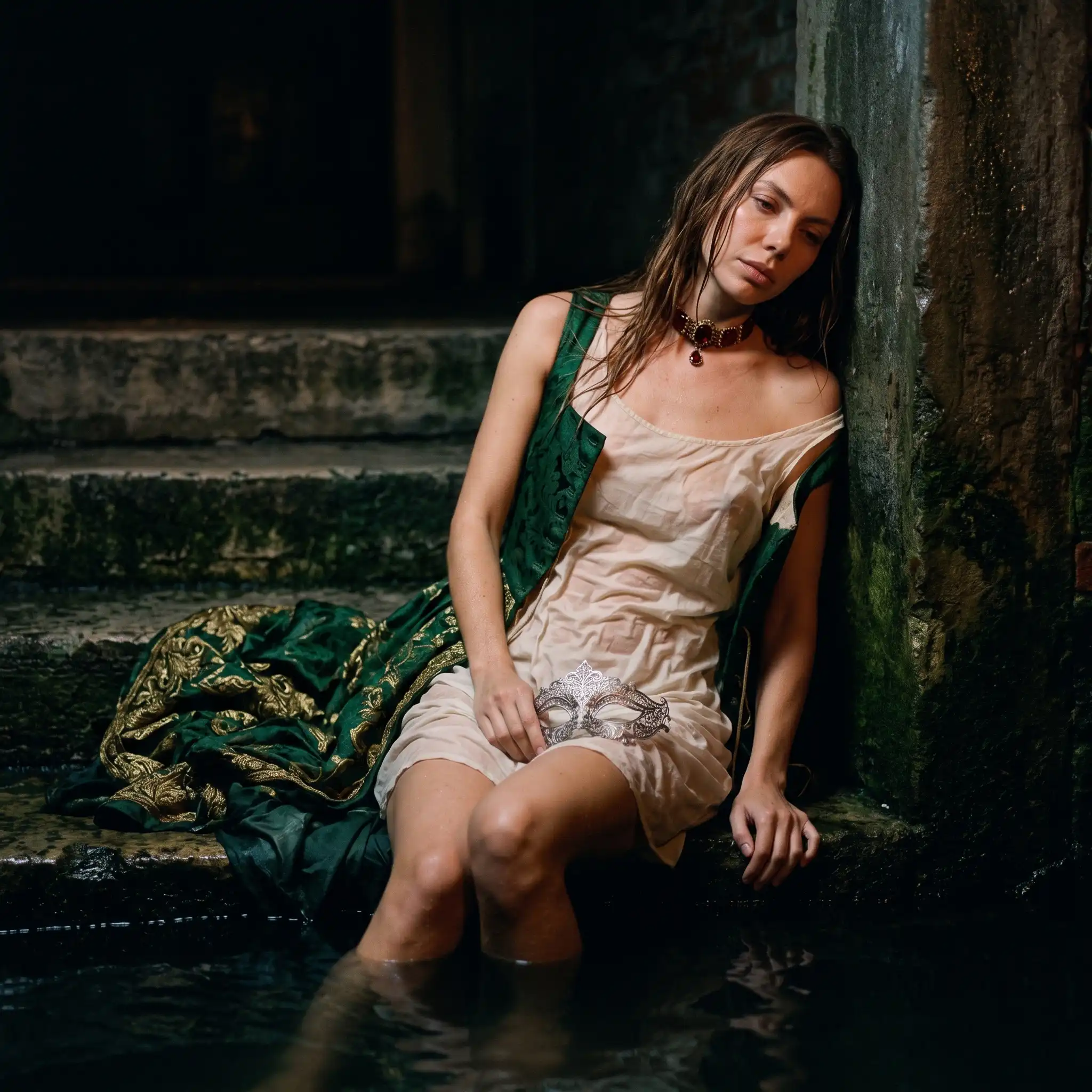
PROMPT
{
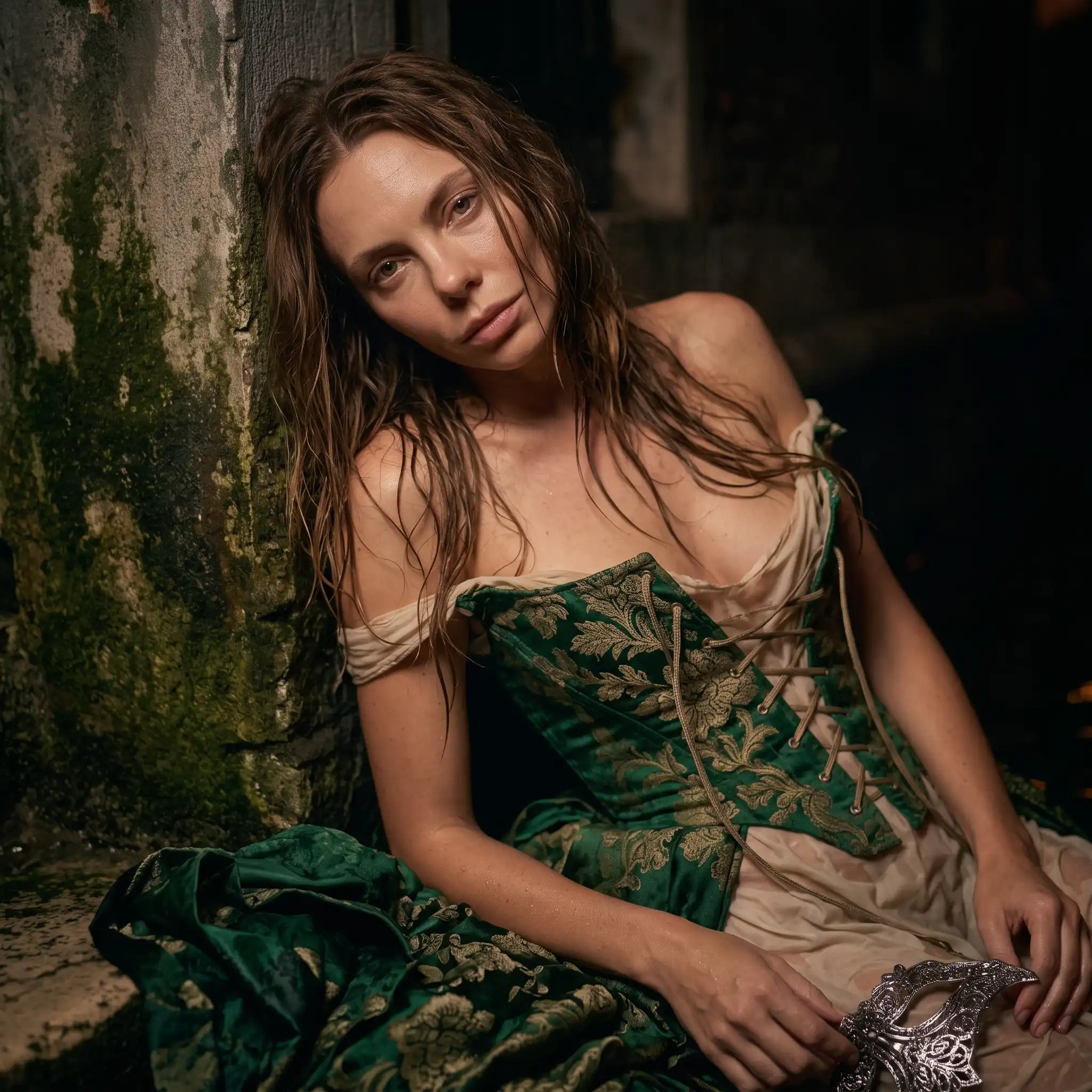
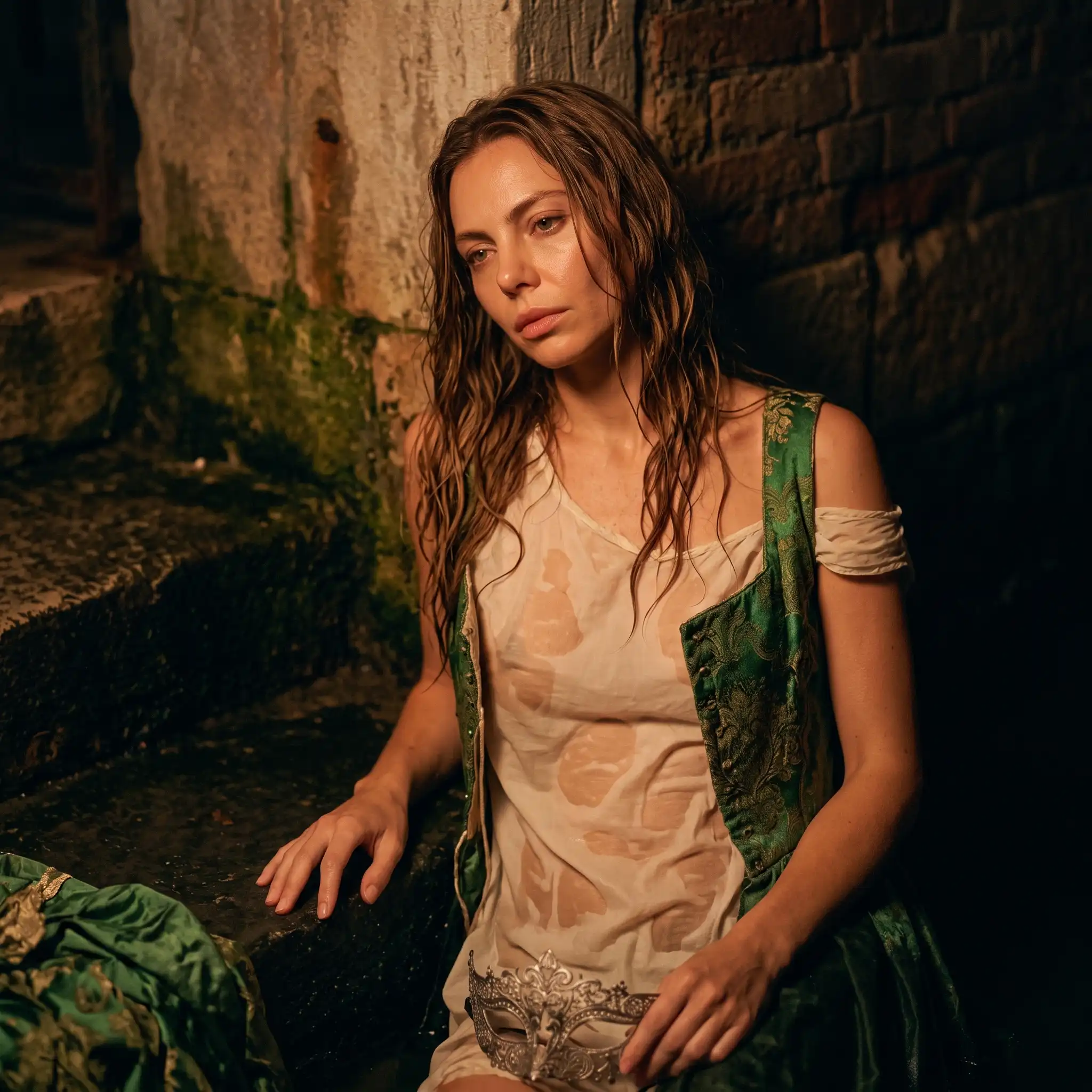
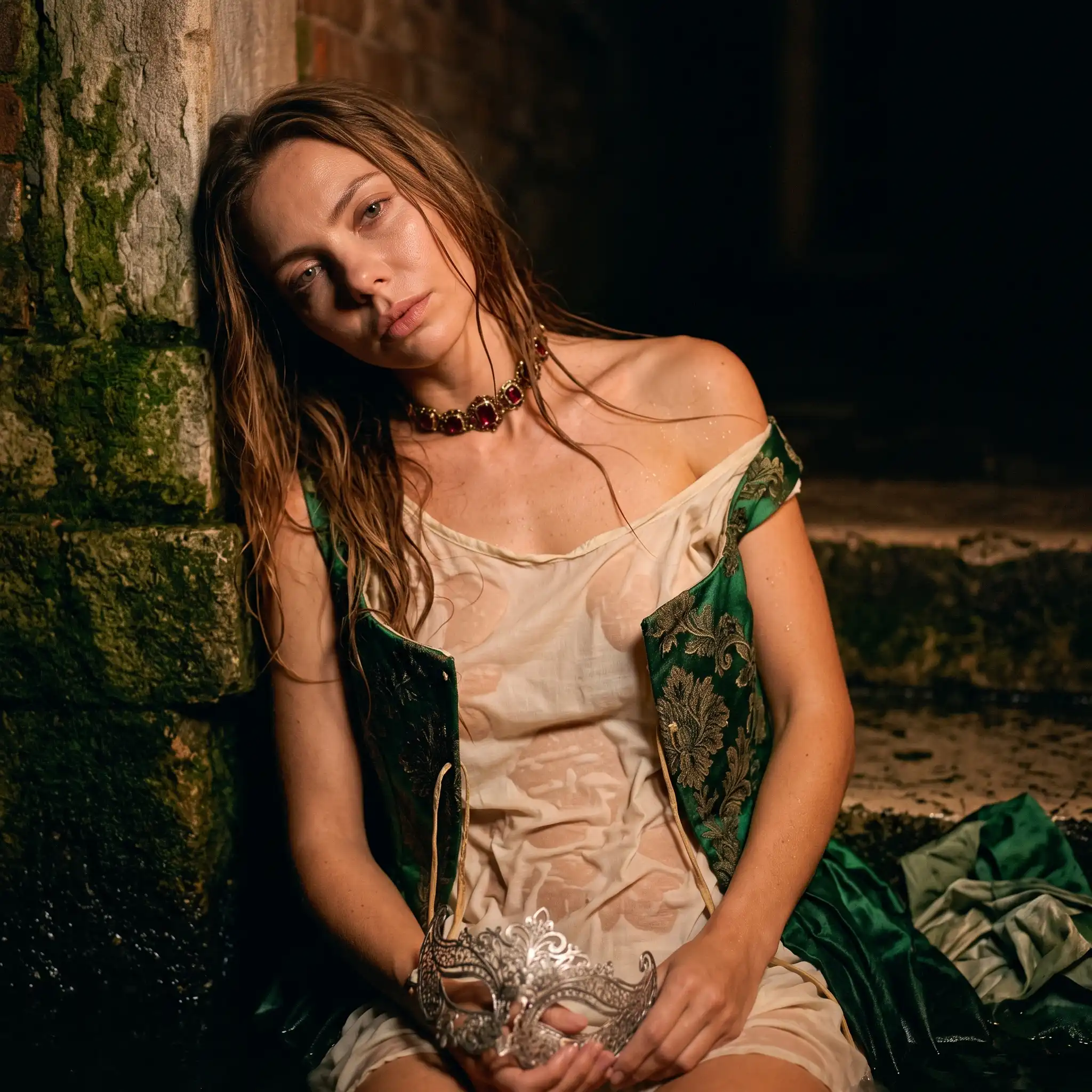
  "core_scene": {
    "concept": "A hyper-realistic Renaissance portrait of an adult Venetian cortigiana onesta, exhausted and sitting on ancient stone steps at a private canal water-gate at deep midnight. She faces the canal, her body slumped against a damp, moss-covered wall, with the back and side of her head resting directly against the cold masonry. Her luxurious emerald brocade gown is soaked and disordered. Its heavy lower skirt has been opened and discarded carelessly on the stone step beside her. Her sleeveless bodice is partially unlaced, and beneath it she wears a short ivory linen chemise completely saturated with canal water.",
    "historical_context": "Sixteenth-century Venice, well after midnight. A secluded waterside entrance beside an aristocratic palazzo. Ancient wet masonry, nearly black canal water, faint mist, and almost total darkness surround the woman. The scene is illuminated by a single weak off-frame torch.",
    "action": "The woman sits facing the water after a long and exhausting night. Her bare feet and lower legs are immersed in the canal. She has slumped backward against the wall, and her head rests directly against the damp stone, tilted slightly to one side. Her loosened emerald bodice hangs open and unevenly across her torso. The heavy wet lower skirt has been pushed aside and abandoned in a crumpled heap on the adjacent step, with its embroidered panels spread apart. Her short ivory linen chemise is thoroughly soaked, heavily creased, darkened by irregular patches of moisture, and closely following her natural silhouette while remaining opaque. One hand loosely holds a silver filigree Volto mask near her lap; the other rests passively on the wet stone step beside her.",
    "narrative": "A private moment in the hidden corners of Renaissance Venice. A once-composed, wealthy courtesan has finally stopped moving. Her heavy wet gown lies discarded beside her, her undergarment is completely drenched, and her body has surrendered to fatigue. There is no audience for her elegance and no performance left in her expression. She sits alone in the cold darkness beside the canal.",
    "emotional_focus": "Deep fatigue, quiet sadness, loneliness, and vulnerability. The viewer should feel sympathy for her. The sensuality comes naturally from the disordered historical clothing, soaked linen, exposed shoulder, and intimate camera position, never from an exaggerated seductive pose."
  },
  "composition": {
    "framing": "An extremely tight cinematic close-up from just above the canal surface, looking slightly upward toward the seated woman. Her face, head against the wall, exposed shoulder, loosened sleeveless bodice, and wet chemise dominate the frame. Only a limited portion of her lap and the discarded brocade skirt on the adjacent step is visible near the lower edge of the composition.",
    "camera_position": "The camera is positioned directly at the water's edge, almost at the surface of the canal and very close to the submerged steps. It looks inward and slightly upward toward the woman. The low viewpoint naturally looks into the open neckline of her loosened bodice.",
    "camera_distance": "Very close and intimate. The image is emphatically a close-up, not a medium portrait or full-body view.",
    "subject_placement": "The woman sits directly against the moss-covered stone wall. Her upper back, one shoulder, and the back and side of her head make clear physical contact with the masonry. Her head is visibly supported by the wall. The nearly black canal occupies the foreground, while the wall rises immediately behind her.",
    "body_orientation": "Her body faces the canal rather than turning squarely toward the lens. Her shoulders remain relaxed and uneven from fatigue. The low camera angle reveals her face and upper body from the front at a slight upward angle.",
    "head_position": "Her head is resting directly against the stone wall. It is tilted slightly sideways, supported by the masonry, with her neck relaxed and her head no longer being held upright by effort. The contact between her hair, head, and wall must be visually unmistakable.",
    "gaze": "Her heavy, tired eyes look quietly toward the water or just beyond the camera. Her gaze is distant and sorrowful, not challenging, flirtatious, or deliberately seductive.",
    "expression": "A visibly weary and sad expression, relaxed facial muscles, subtly lowered mouth corners, and tired eyes. No smile. Her face should evoke compassion without exaggerated crying or theatrical despair.",
    "hand_positions": {
      "mask_hand": "One hand loosely holds the delicate silver filigree Volto mask near her lap. The hand is relaxed and partially lost in shadow, with a few fine silver edges catching faint amber torchlight.",
      "resting_hand": "Her other hand rests passively on the wet stone step beside her. The fingers are relaxed and naturally positioned.",
      "body_support": "The wall, rather than an exaggerated arm pose, supports her slumped upper body and resting head."
    },
    "discarded_gown_visibility": "The lower skirt, opened and thrown onto the adjacent step, enters the lower edge or one side of the frame. A small section of its saturated emerald brocade, separate embroidered panels, and heavy wet folds must remain identifiable. Do not widen the camera framing merely to show the entire discarded garment.",
    "visual_hierarchy": [
      "Her sad, exhausted face",
      "The back and side of her head visibly resting against the wet stone wall",
      "The extremely close viewpoint from the dark canal",
      "The open, partially unlaced sleeveless bodice and soaked ivory chemise",
      "The discarded lower skirt, visible at the edge of the close composition",
      "The silver filigree mask",
      "A small patch of mossy stone caught by the weak torchlight"
    ],
    "depth": "The face is the primary focal point. Her eyes, tired expression, and contact with the wall remain legible. The neckline, wet chemise, and limited visible area of brocade are readable where the flame reaches them. The canal, discarded skirt beyond its nearest folds, and background architecture recede into near-total darkness.",
    "visual_restraint": "Keep the framing extremely close and the illuminated area small. Do not brighten the surrounding space to reveal more of the location. Genuine darkness is essential to the image."
  },
  "subject": {
    "identity": "An adult Venetian cortigiana onesta, a wealthy, educated, and socially accomplished woman accustomed to influential patrons.",
    "presence": "Dishevelled Renaissance opulence. Her precious clothing and accessories remain visible, but her composure has collapsed into quiet physical exhaustion.",
    "pose": "Seated on the old stone steps facing the canal. Her upper back and one shoulder lean heavily against the wall. Her head rests directly against the masonry, tilted slightly sideways. Her feet and lower legs are submerged in the canal, and the heavy lower skirt of her gown lies discarded on the step beside her.",
    "body_language": "Unposed, physically tired, and emotionally withdrawn. Her lowered shoulders, supported head, relaxed hands, and slumped posture convey genuine fatigue. She is not arranging her body for the camera.",
    "expression": "Quietly sad, exhausted, and distant. Relaxed lips, tired eyes, and slight natural tension around the mouth. No smile, theatrical despair, or exaggerated seduction.",
    "gaze": "Directed toward the dark water or just beyond the camera, as though lost in thought. Her gaze must not become an intense, deliberately provocative stare.",
    "hair": "Completely loose, wet, and slightly disordered hair falling naturally around her face, neck, and exposed shoulder. A few strands cling to her cheek and temple. No elaborate updo, hairpins, gold ornaments, decorative combs, or other hair accessories.",
    "skin_and_moisture": "Small droplets remain on her exposed shoulder, collarbones, neck, and visible skin. Only droplets directly facing the torch catch tiny amber highlights. Most skin remains subdued in the deep shadows, with no broad glossy reflections.",
    "hands": "Both hands have natural anatomy, believable finger placement, and relaxed positions. One loosely holds the silver mask; the other rests on the wet stone step.",
    "characterization": "The woman is not portrayed as triumphant, playful, or performing for a viewer. Her wealth remains apparent through the brocade, ruby choker, and silver mask, while the discarded skirt, drenched chemise, and exhausted posture suggest that she has reached the end of a difficult night."
  },
  "wardrobe": {
    "outer_gown": {
      "garment": "A luxurious sixteenth-century Venetian ensemble consisting of a fitted, sleeveless emerald brocade bodice and a separate open-front lower skirt made from two embroidered panels.",
      "material": "Rich emerald-green silk brocade, with deep jewel-green tones that approach near-black in shadow.",
      "ornamentation": "Intricate Renaissance botanical motifs woven in restrained antique-gold thread. The embroidery remains subdued, never bright or excessively metallic.",
      "upper_construction": "A fitted Renaissance bodice with front lacing, historically inspired seams, and structured panels. The bodice remains on her upper body while its front lacing is substantially undone.",
      "sleeve_rule": "Absolutely no sleeves: no long sleeves, short sleeves, puff sleeves, detached sleeves, or fabric covering either upper arm.",
      "bodice_condition": "The front lacing is substantially loosened. The bodice edges sit unevenly, the opening is deep and irregular, and the upper structure has partially fallen out of place through movement and fatigue.",
      "shoulder_arrangement": "One shoulder is clearly exposed by the asymmetrically loosened upper edge. Neither shoulder has a sleeve.",
      "skirt_construction": "The lower gown consists of two separate embroidered outer panels, with no continuous central front skirt panel.",
      "skirt_condition": "The heavy lower skirt has been opened and pushed aside, then left in a careless, waterlogged heap on the stone step immediately beside her. The separate embroidered panels lie apart, tangled in irregular folds.",
      "skirt_placement": "Part of the discarded skirt rests on the step beside her hip, with some of the heavy wet hem hanging toward the lower step near the canal. The closest folds are visible at the edge of the tight camera framing.",
      "central_opening": "The front of the gown remains open. The short ivory chemise is visible beneath the loosened bodice and across the limited portion of the lower torso that fits within the close composition.",
      "wetness": "The brocade is saturated with canal water. The fabric is darkened, heavy, and visibly wet, with droplets and occasional muted highlights where the flame grazes the folds.",
      "fabric_physics": "The discarded brocade retains substantial weight and believable volume. It collapses across the step under gravity, producing irregular, compressed folds rather than floating or arranging itself neatly.",
      "visual_character": "Expensive Renaissance attire in a state of complete disarray. The dark emerald brocade contrasts against the much paler soaked linen beneath it."
    },
    "chemise": {
      "garment": "A short, fine Renaissance linen chemise worn beneath the sleeveless bodice. It remains on the woman after the heavy lower skirt has been discarded.",
      "material": "Pale ivory linen with a delicate woven texture and understated historical edging.",
      "construction": "A simple sleeveless undergarment with narrow shoulder straps or a soft low-cut upper edge. No sleeves or fabric covering the upper arms.",
      "length": "A short undergarment ending around the upper-to-mid thigh. Only the sections permitted by the tight close-up are visible.",
      "condition": "Completely saturated with canal water. The linen is waterlogged, heavy, deeply creased, and visibly darkened by irregular moisture patches. It looks cold and uncomfortable rather than freshly damp.",
      "neckline": "A low, relaxed neckline sitting unevenly across the collarbones. One side has slipped lower, complementing the loosened bodice and exposed shoulder.",
      "upper_fit": "The saturated linen clings closely across the chest and torso through natural fabric contact and tension. Fine wrinkles, compressed folds, and darkened moisture patches form beneath the neckline and along the sides.",
      "waist_and_hip_fit": "The soaked fabric follows the waist and hips naturally, with irregular wet creases and soft folds caused by her seated posture.",
      "lower_fit": "The chemise rests close against the upper thighs and pelvic area. Its saturated fabric follows the general silhouette but remains recognizably linen.",
      "water_detail": "Small droplets remain on the fabric. Its lower hem is heavily wet, with darkened edges and occasional droplets falling from the saturated folds.",
      "opacity": "The chemise is thoroughly soaked but remains opaque enough to cover intimate anatomy. Its wet appearance comes from close contact, fabric tension, weave texture, wrinkles, and darkened patches rather than transparency.",
      "visual_priority": "The wet ivory linen is the brightest clothing element, but only within the small area directly struck by torchlight. It must not glow white or illuminate the rest of her body.",
      "historical_character": "A fine linen Renaissance chemise, not modern lingerie, a modern slip dress, or a contemporary camisole."
    },
    "jewelry": {
      "necklace": "A substantial choker set with dark ruby gemstones in a refined Renaissance-inspired setting.",
      "gemstones": "Deep oxblood red and dark crimson, almost black in shadow, with very restrained red undertones where the flame reaches their facets.",
      "metalwork": "Darkened gold or antique gold with delicate historical ornament.",
      "light_interaction": "Only a few tiny warm reflections appear on the gemstones. The necklace remains mostly concealed in shadow."
    },
    "mask": {
      "object": "A delicate Venetian Volto mask crafted from silver filigree.",
      "material": "Fine silver wirework with intricate open patterns and a subdued, aged metallic finish.",
      "condition": "Elegant and well preserved, with subtle darkening in recessed details.",
      "position": "Held loosely in one hand near her lap, partially visible at the lower edge of the close composition.",
      "meaning": "The removed mask symbolizes the transition from public identity and social performance to a private moment of vulnerability.",
      "light_interaction": "Only a few thin edges catch the torch's muted orange-amber light. The mask remains predominantly dark, with no cool metallic shine."
    },
    "overall_appearance": "A dishevelled Renaissance courtesan seated against a stone wall, head resting against the masonry, with loose wet hair, one exposed shoulder, a sleeveless emerald bodice partially unlaced, and a completely soaked, opaque ivory linen chemise. Her heavy lower skirt lies opened and crumpled on the adjacent step. A dark ruby choker and silver filigree mask retain the impression of wealth."
  },
  "environment": {
    "location": "A secluded private water-gate beside a Venetian palazzo, opening directly onto a narrow canal.",
    "time": "Deep night, well after midnight.",
    "night_rule": "The scene takes place in complete nocturnal darkness. No twilight, dusk, dawn, blue hour, pre-sunrise glow, visible bright sky, or ambient daylight. The night must remain unmistakably dark throughout the entire image.",
    "stone_wall": {
      "material": "Ancient Venetian masonry with irregular stone blocks, weathered edges, mineral stains, and patches of dark moss.",
      "surface_condition": "Damp from canal water, mist, and persistent humidity.",
      "moss": "Deep green moss embedded in shaded joints and crevices, visible only where the weak torchlight grazes the wall.",
      "contact": "The woman's upper back and one shoulder lean against the wall. The back and side of her head rest directly against the stone, visibly supported by the masonry.",
      "illumination": "Only a small section of wall around her head and shoulder is faintly revealed. The masonry immediately outside this patch disappears into blackness.",
      "historical_character": "Old masonry continually exposed to canal water, mist, and centuries of weather."
    },
    "stone_steps": {
      "structure": "Uneven ancient stone steps descending directly into the canal.",
      "surface": "Wet, dark, weathered stone, with irregular edges, subtle mineral stains, and slick patches.",
      "gown_position": "The opened, waterlogged lower skirt has been carelessly discarded on the step immediately beside the woman. Its nearest embroidered folds are visible at the edge of the close frame.",
      "illumination": "The steps are almost completely black. Only a limited patch near the woman's body receives weak amber torchlight, with rapid falloff into darkness."
    },
    "canal": {
      "water_color": "Almost completely black, with deep neutral-black and charcoal tones. No blue, cyan, or teal cast.",
      "surface": "Gentle, subtle ripples around her immersed legs. The water absorbs almost all available light.",
      "torch_reflections": "Only a few sparse, narrow, fragmented orange-amber reflections appear on the surface, originating from the single torch.",
      "sky_reflection": "No visible sky reflection, blue ambient glow, or bright atmospheric gradient. The water reflects mostly darkness.",
      "brightness": "Extremely low. The canal must not become a secondary light source and must not illuminate the woman's face, torso, or clothing from below.",
      "foreground": "The immediate water surface occupies the low foreground and establishes that the camera is positioned directly at the canal's edge.",
      "atmosphere": "A thin layer of mist is visible only where the torch's flame catches it. No cool or luminous haze."
    },
    "water_gate": {
      "structure": "An old private stone entrance at canal level, with worn masonry and historically plausible architectural details.",
      "visual_presence": "The waterline, ancient wall, submerged steps, and the woman's position establish the location without requiring a wide shot.",
      "details": "Eroded corners, darkened joints, moss-filled crevices, and subtle carved stone edges."
    },
    "background": {
      "architecture": "Distant Venetian palazzo facades and canal-side buildings appear, at most, as faint silhouettes.",
      "visibility": "Nearly black. The architecture is barely distinguishable except for the rare, weak, warm edge highlight.",
      "people": "No other people visible.",
      "modern_elements": "No contemporary fixtures, electric lights, modern boats, signage, or present-day urban details."
    },
    "atmosphere": "A profoundly dark, damp, private Venetian nocturne. Nearly black water, moss-covered stone, wet linen, loose hair, and a single warm flame define the setting. Darkness occupies most of the frame."
  },
  "lighting": {
    "style": "Extremely low-key torchlight photography with strong chiaroscuro, warm flame-colored illumination, and deep, uncompromising shadows.",
    "only_light_source": "One weak off-frame torch. This torch is the sole source of meaningful illumination for the woman's face, body, clothing, wall, steps, water, and background.",
    "source_visibility": "The torch itself does not need to appear in the frame. Its presence is conveyed by the directional amber-orange color, small illuminated area, subtle flickering quality, and extremely rapid falloff of its light.",
    "intensity": "Very weak illumination. Only a small, localized patch of the woman and nearby wall is visible. The rest of the scene remains nearly black.",
    "light_direction": "A narrow, oblique light from one side, grazing a small portion of her face, exposed shoulder, wet chemise, selected folds of the bodice, the nearest silver edges of the mask, and a limited patch of mossy stone. The light does not come from the camera axis.",
    "color_rule": "All visible illumination must be colored by the flame: warm amber, burnt orange, muted copper, and faint reddish-orange. No neutral-white light, cool light, blue ambient fill, cyan highlights, or moonlit illumination.",
    "on_face": "Only a small portion of her tired face receives warm torchlight. The light reveals part of one cheek, the tired eyes, and the natural tension around her mouth, while the opposite side falls into deep shadow. Her sad expression remains discernible, but the face is never evenly illuminated.",
    "on_head_and_wall": "The small patch of stone behind her head receives enough grazing light to make the physical contact between her head and the wall unmistakable. Her damp hair catches only a few warm highlights. The rest of the wall remains almost invisible.",
    "on_skin": "Only droplets and skin surfaces directly facing the flame catch tiny orange-amber highlights. There are no broad glossy reflections across the chest, shoulders, or arms.",
    "on_chemise": "The pale wet linen becomes visible only where it faces the flame. Its texture, folds, and moisture patches fade rapidly into shadow instead of glowing white or illuminating the entire torso. The fabric must not act as a large reflected light source.",
    "on_bodice": "Only selected emerald folds and small areas of antique-gold embroidery catch muted warm highlights. Most of the bodice remains dark emerald or near-black.",
    "on_discarded_gown": "The skirt on the adjacent step is almost entirely swallowed by shadow. A few nearby wet folds and embroidered edges may catch a dim amber glint. Do not illuminate the entire discarded garment.",
    "on_stone": "The torch grazes only a small patch of wet masonry, revealing rough texture and dark moss. The light falls off sharply along the wall and steps.",
    "on_mask": "A few thin silver edges reflect muted orange-amber highlights. The mask remains predominantly dark and never shines with a cold white or blue metallic gleam.",
    "on_water": "The nearly black canal shows only rare, dim, broken amber reflections. The water provides no meaningful fill light and never lights the woman from below.",
    "background": "The background is nearly invisible. No cool haze, ambient architectural lighting, bright sky, or illuminated buildings are permitted.",
    "light_falloff": "Extremely rapid and uneven. The brightest area is a small patch directly facing the torch. Illumination drops sharply across her face, clothing, and nearby stone, disappearing into deep darkness.",
    "shadow_quality": "Deep, dense shadows with little recoverable detail. The darkness is deliberate, dominant, and essential to the composition. Do not lift the shadows during rendering or post-processing.",
    "exposure": "Intentionally underexposed by approximately two stops compared with a conventional portrait. Detail is retained only in the limited areas reached by the weak torch.",
    "highlight_control": "Small, warm, localized highlights only. No white reflections, broad fill, bright facial illumination, or appearance of camera flash.",
    "forbidden_lighting": [
      "Neutral white light",
      "Cool or blue light",
      "Moonlight",
      "Daylight",
      "Twilight",
      "Dusk",
      "Dawn",
      "Blue-hour ambience",
      "Bright sky glow",
      "Ambient fill light",
      "Multiple light sources",
      "Camera flash",
      "Studio lighting",
      "Beauty lighting",
      "Frontal fill light",
      "Broad illumination across the torso",
      "Evenly illuminated face",
      "Evenly illuminated body",
      "Bright skin",
      "Overexposed chemise",
      "Glowing white fabric",
      "Brightly illuminated discarded skirt",
      "Broad glossy skin highlights",
      "Strong reflected light from the canal",
      "Water acting as a reflector or fill source",
      "Artificially brightened shadows",
      "HDR shadow recovery",
      "Evenly lit wall",
      "Brightly visible background",
      "Luminous mist",
      "Strong lens flare",
      "Excessive bloom"
    ]
  },
  "textures_and_physical_detail": {
    "brocade": "Dense, richly woven emerald fibers with subdued antique-gold embroidery. Details appear only where the weak torch grazes the material. The saturated fabric has a heavy, waterlogged drape.",
    "discarded_skirt": "The lower skirt lies in a careless heap on the wet stone step. Its separate panels are open and apart, compressed where the fabric rests on the step, and irregularly folded under their own weight. The hem is soaked and darkened. No neat arrangement or weightless folds.",
    "bodice": "Partially loosened front lacing, displaced edges, relaxed structure, and realistic asymmetry caused by the woman's slumped posture and wet clothing.",
    "chemise": "Fine linen weave, completely saturated fibers, irregular darkened moisture patches, heavy creases, and close-fitting drape. The fabric clings naturally to the torso and visible upper thighs but remains opaque.",
    "wet_hem": "The chemise hem is heavily soaked, with uneven folds, darker edges, and small droplets clinging to the saturated linen.",
    "water_droplets": "Small droplets on the chemise, exposed shoulder, arms, neck, and neckline. Only droplets directly facing the flame catch tiny warm highlights.",
    "stone": "Rough mineral texture, worn edges, darkened joints, and damp patches revealed selectively by raking torchlight.",
    "moss": "Dark green moss with sparse, muted warm highlights, mostly lost in shadow.",
    "skin": "Natural skin texture, subdued highlights, and no uniform glossy coating or beauty retouching.",
    "hair": "Loose, wet strands in mild disarray, with a few individual strands catching warm light. No hair ornaments, decorative pins, or elaborate styling.",
    "ruby_gems": "Dark crimson facets with extremely limited warm reflections.",
    "silver_mask": "Aged filigree with a few thin orange-amber reflections along its edges.",
    "canal_water": "Almost black, with subtle surface movement and very sparse warm reflections.",
    "film_texture": "Strong, unmistakably visible organic 35mm film grain consistent with high-speed film at ISO 6400–12800. Grain is prominent in the shadows, gown, stone, hair, and near-black water.",
    "grain_character": "Irregular analogue grain with clearly visible luminance texture and subtle color grain. It disrupts smooth shadow gradients and dark surfaces without becoming uniform digital pixel noise.",
    "shadow_texture": "Dark areas remain imperfect, grainy, and underexposed instead of being digitally denoised, brightened, or smoothed.",
    "rendering": "Preserve authentic darkness and visible grain. Do not smooth, brighten, clean, denoise, or recover detail in unlit regions."
  },
  "photographic_style": {
    "genre": "Historical fine-art portraiture with raw, high-ISO low-light analogue photography.",
    "visual_language": "Renaissance Venetian atmosphere, strong chiaroscuro, intimate water-level perspective, and imperfect nocturnal film photography.",
    "camera_character": "A vintage fast 50mm lens rendering in extremely low light, with natural perspective, shallow depth of field, and slight optical softness.",
    "framing": "An extremely tight close-up from the canal surface emphasizing her tired eyes, head visibly resting against stone, loose wet hair, sleeveless bodice, soaked chemise, and a small glimpse of the discarded wet skirt.",
    "focus": "Her eyes and exhausted expression are the clearest points of focus. The contact between her head and the wall must remain visually legible. The open neckline, wet linen, and nearest folds of the discarded skirt are readable only where weak torchlight reaches them.",
    "depth_of_field": "Shallow but natural. The background disappears into darkness rather than bright artificial bokeh. Darkness, not a luminous blur, dominates the unlit areas.",
    "exposure_style": "A genuinely underexposed night photograph captured at very high ISO using one weak torch. The image is not brightened in post-processing. Preserve deep blacks and limited shadow detail.",
    "film_grain": "Strong, clearly visible organic 35mm film grain equivalent to ISO 6400–12800. The grain must be noticeable at normal viewing size, especially in dark water, stone, the gown, and shadows. No digital denoising or smooth shadow gradients.",
    "tonal_response": "Deep blacks, compressed highlights, subdued midtones, visible shadow grain, and imperfect analogue tonal transitions.",
    "color_grading": "Flame-colored orange-amber highlights against deep black shadows, near-black canal water, green-black stone, and dark emerald fabric. No neutral or cool ambient illumination.",
    "finish": "Gritty, dark, imperfect, and tactile. The result should resemble an intimate photograph captured under extremely poor lighting rather than a clean modern digital portrait."
  },
  "mood_and_story": {
    "mood": [
      "Melancholic",
      "Intimate",
      "Vulnerable",
      "Nocturnal",
      "Quiet",
      "Mysterious",
      "Historically grounded"
    ],
    "emotional_tone": "Her expression conveys deep fatigue and quiet sadness. Her head rests against the cold wall, her shoulders have dropped, and her eyes have lost any performative confidence. The viewer should feel concern and sympathy rather than being invited into a staged seductive encounter.",
    "social_identity": "The brocade, dark rubies, and silver filigree mask establish the cultivated, wealthy world of a high-status Venetian courtesan. Her status contrasts with her present physical exhaustion.",
    "symbolism": "The discarded lower gown suggests that she can no longer bear its weight. The completely soaked chemise records her contact with the canal. The removed Volto mask marks the transition from public identity to private vulnerability.",
    "sensual_subtext": "The visual intimacy comes from the partially unlaced bodice, exposed shoulder, saturated linen, damp skin, and low camera angle. The image remains suggestive, historical, and non-explicit.",
    "viewer_relationship": "The viewer observes her from the water at very close range, as though accidentally encountering a private moment. Her gaze remains sad and distant, never a deliberate seductive performance.",
    "storytelling": "She sits on the cold stone steps in the darkness beside the nearly black canal. Her heavy wet skirt has been thrown aside, the soaked chemise clings to her body, and her head rests against the wall. A single weak torch barely reveals her face before the light disappears into shadow."
  },
  "final_goal": "Create a hyper-realistic, intimate Renaissance portrait of an adult Venetian cortigiana onesta seated on old stone steps at a private canal water-gate at deep midnight. The framing must be an extremely tight close-up from just above the canal surface, looking slightly upward toward her face, exposed shoulder, and loosened bodice. She sits facing the water. Her upper back and one shoulder lean heavily against a damp, moss-covered stone wall, and the back and side of her head rest directly against the masonry. Her head is tilted slightly sideways and visibly supported by the wall, conveying genuine exhaustion. Her expression is deeply tired and quietly sad, with heavy eyes, relaxed lips, and no smile or exaggerated seductive gaze. Her hair is completely loose, wet, and slightly disordered, with no ornaments, pins, or elaborate updo. She wears a completely sleeveless emerald-green Renaissance brocade bodice with restrained antique-gold embroidery. The bodice is substantially unlaced and hangs open unevenly, with one shoulder exposed. Beneath it, her short pale ivory linen chemise is completely saturated with canal water: heavy, creased, darkened by irregular moisture patches, and closely following her natural silhouette while remaining opaque. The heavy lower skirt of her gown has been opened and discarded carelessly on the stone step beside her. Its two separate embroidered panels lie apart in a waterlogged heap, with only the nearest wet folds visible at the edge of the close composition. One hand loosely holds a silver filigree Volto mask near her lap; her other hand rests passively on the wet step. Her bare feet and lower legs are immersed in the canal, although they need not be visible in this tight shot. The time must be unmistakably deep night, well after midnight. The canal is almost entirely black, with only a few extremely faint, broken amber reflections. All meaningful illumination comes from one weak off-frame torch. Its light is exclusively flame-colored: warm amber, burnt orange, muted copper, and faint reddish-orange. No neutral-white light, blue light, moonlight, twilight, dawn, ambient fill, or secondary illumination. The weak torch illuminates only a small portion of her tired face, a few damp strands of hair, selected areas of her exposed shoulder and saturated chemise, a few folds of emerald brocade, the edge of the silver mask, and a limited patch of mossy masonry behind her head. The light must fall off rapidly, leaving most of her body, the discarded skirt, the canal, and the background in near-total darkness. The water must not act as a source of fill light. Do not brighten the shadows to recover details. The image must feel genuinely underexposed by approximately two stops, as though photographed in an extremely dark Venetian canal-side setting with one weak torch. Capture the scene as high-ISO 35mm analogue photography equivalent to ISO 6400–12800, with unmistakably visible organic film grain across the image, especially in the shadows, water, stone, wet fabric, and hair. Preserve irregular grain, imperfect shadow detail, softened microcontrast, restrained warm highlights, and imperfect analogue tonal transitions. No digital denoising, lifted blacks, HDR, studio lighting, or clean modern digital finish. Prioritize authentic nocturnal darkness, single-source torch illumination, the head resting against the wall, a sympathetic exhausted expression, completely soaked linen, the discarded wet lower gown, and pronounced organic film grain.",
  "negative_prompt": "wide shot, full-body portrait, distant camera, medium shot, eye-level camera, high-angle camera, head held upright, head not touching the wall, head floating near the wall, head tilted forward, head resting on her hand, rigid upright posture, fashion-model pose, deliberate pin-up pose, challenging seductive stare, exaggerated provocative expression, smiling, laughing, cheerful expression, theatrical crying, exaggerated despair, clean dry chemise, lightly damp chemise, pristine clothing, neatly arranged skirt, folded gown, lower skirt still fully draped around her legs, sleeves, long sleeves, short sleeves, puff sleeves, detached sleeves, fabric covering upper arms, petticoat, underskirt, transparent wet fabric, sheer chemise, explicit nudity, visible nipples, visible intimate anatomy, twilight, dusk, dawn, blue hour, daylight, bright sky, blue water, cyan water, teal water, broad water reflections, luminous canal, water acting as fill light, blue ambient light, moonlight, neutral white lighting, cool lighting, bright ambient haze, multiple light sources, bright reflected sky, illuminated buildings, flash-lit subject, camera flash, frontal fill light, studio lighting, beauty lighting, broad illumination across the torso, evenly illuminated face, evenly illuminated body, bright skin, overexposed chemise, glowing white fabric, brightly illuminated discarded skirt, broad glossy skin highlights, artificially brightened shadows, HDR shadow recovery, strong bounce light, evenly lit wall, brightly visible background, luminous mist, lens flare, excessive bloom, clean denoised shadows, smooth digital gradients, pristine modern digital photograph, modern mirrorless-camera sharpness, clinical microcontrast, absence of visible grain, barely visible grain, digital noise reduction, overly smooth skin, excessive sharpening, coarse square pixel noise obscuring the eyes, green chemise, dry hair, dry clothing, modern lingerie, modern clothing, modern buildings, electric streetlights, modern boats, visible crowds, bright emerald saturation, bright silver embroidery, sparkling jewelry, excessive orange color cast, elaborate updo, hairpins, gold hair ornaments, decorative combs, braided crown, floral hair accessories, elaborate hair jewelry, deformed hands, extra fingers, duplicated limbs, warped mask, distorted face, text, captions, logos, watermarks, UI elements"
}
СГЕНЕРИРОВАНО В
РЕФЕРЕНС